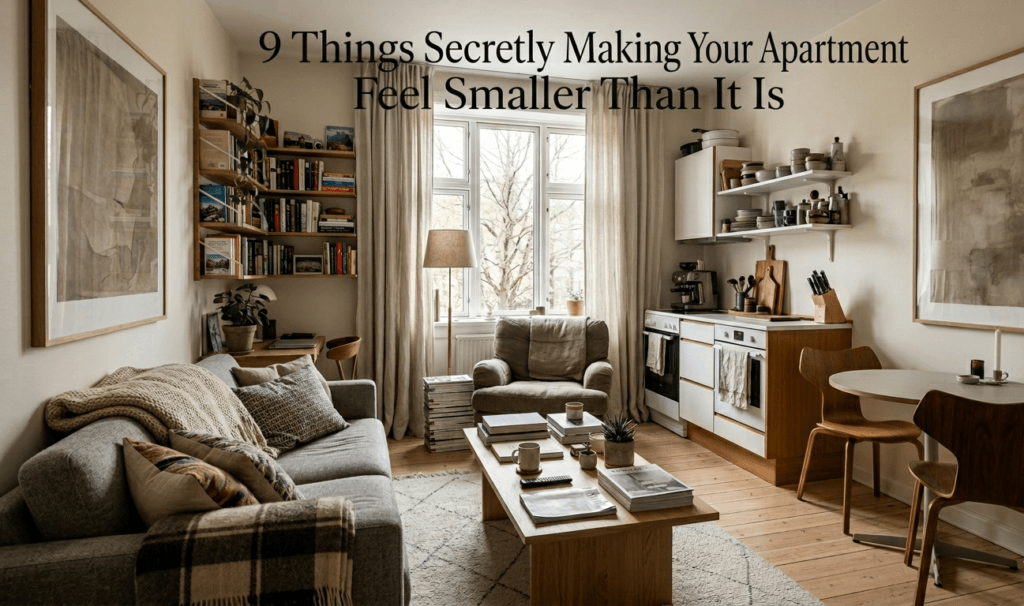
For a long time, I thought a small apartment felt small because there simply was not enough space.
A bigger living room would fix it.
A larger bedroom would fix it.
More storage would fix it.
At least that is what I assumed.
But the more I looked at small apartments, studio spaces, and tiny rooms that still felt calm and beautiful, the more I started noticing something else.
Some of the smallest homes did not feel small at all.
They felt light.
They felt intentional.
They felt easy to move through.
And then there were other apartments that technically had more space, but somehow felt cramped, cluttered, and visually heavy.
That is when I realized the problem is not always square footage.
Sometimes it is the little things.
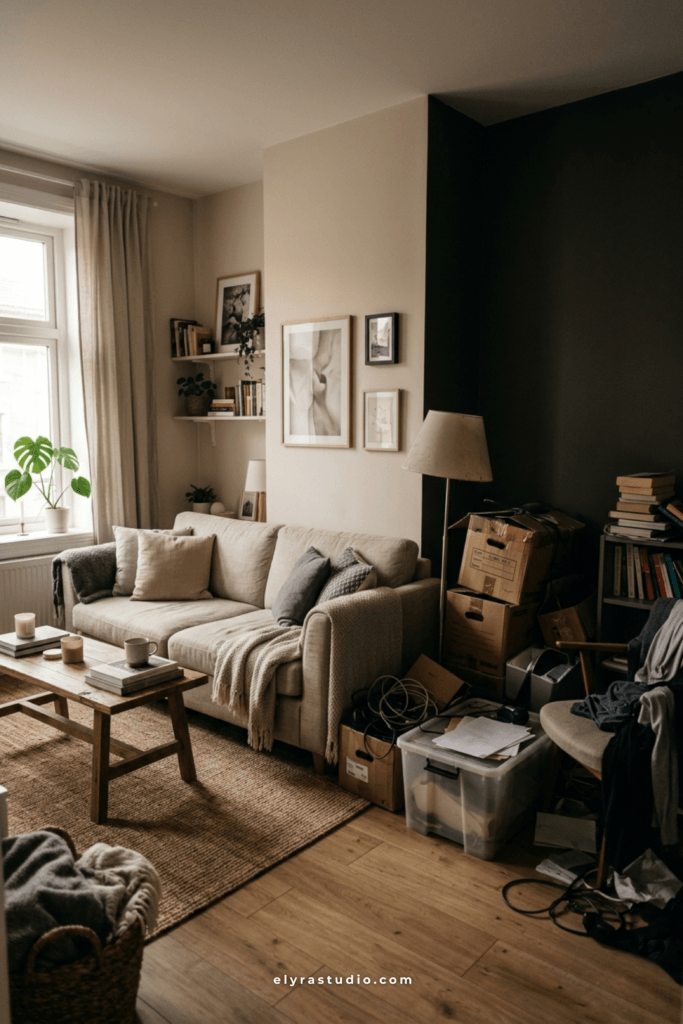
The coffee table you keep walking around.
The open storage that makes every corner feel busy.
The dark spot that makes the room feel closed in.
The rug that is just a little too small.
The shelf that has too many cute things on it.
The apartment may not actually be messy. It may not even be badly decorated. But something about it feels tight.
And honestly, that is good news.
Because it means you probably do not need a bigger apartment.
You do not need to renovate.
You do not need to replace everything you own.
Most small spaces do not need a dramatic makeover. They just need less visual noise, better flow, softer lighting, and a little more breathing room.
Here are the things that may be secretly making your apartment feel smaller than it really is.
1. Furniture That Blocks The Natural Flow
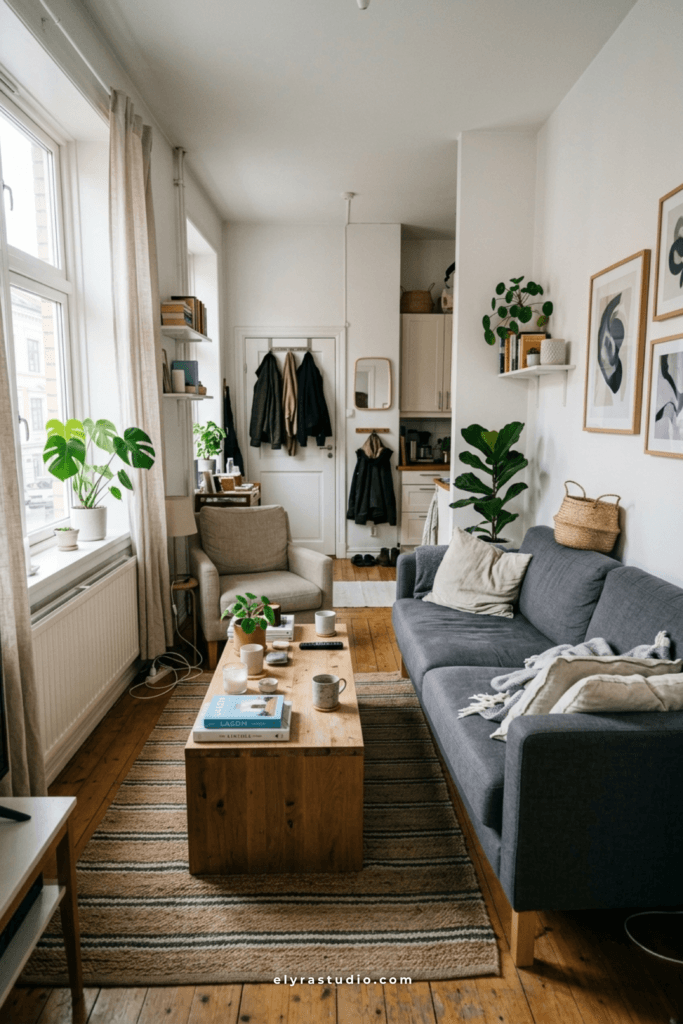
One of the fastest ways to make an apartment feel smaller is placing furniture where your body naturally wants to move.
This happens so easily in small living rooms and studio apartments.
A coffee table sits slightly too close to the sofa.
A chair blocks the walkway.
A side table sticks out just enough to interrupt the path.
A dining table technically fits, but every time you pass it, you have to turn your body a little.
Nothing looks obviously wrong.
But the room feels tight.
I always notice this first in a small space. If walking through the room feels awkward, the apartment immediately feels smaller.
The room may be clean. The furniture may be pretty. The layout may even look fine in photos.
But if you have to constantly move around furniture, your home starts to feel like it is working against you.
The small-space fix
Create one clear path through the room.
You do not need to remove half your furniture. Sometimes a few inches make a surprising difference.
Move the coffee table slightly farther from the sofa.
Push the accent chair closer to the wall.
Swap a sharp rectangular table for a round one.
Use nesting tables instead of one heavy coffee table.
Choose a slim console instead of a deep cabinet.
Think about a small living room where you have to squeeze between the sofa and coffee table every single day.
The coffee table may be beautiful.
But if it interrupts the way you move through the room, it is quietly making the apartment feel smaller.
Replace it with a smaller round table or a soft ottoman, and suddenly the space feels easier.
The room did not get bigger.
But your body can move through it more naturally.
That changes the entire feeling of the apartment.
Quick tip: If you have to walk around a piece of furniture every day, it may be stealing more space than you think.
2. Too Many Things Sitting On The Floor
Floor space is one of the most valuable things in a small apartment.
The more floor you can see, the more open the room usually feels.
But small apartments often collect floor clutter without anyone noticing.
A basket by the sofa.
A shoe rack by the door.
A laundry hamper in the bedroom.
A plant stand in the corner.
A storage bin under the desk.
A tote bag beside the entry.
A small stool that keeps getting moved around.
None of these things are wrong on their own.
That is what makes this so tricky.
Each item seems useful. Each one has a reason to be there. But together, they make the apartment feel visually heavy.
I think this is one of the easiest small-space mistakes to miss because it does not always look like clutter.
It looks like storage.
It looks practical.
But the room still feels full.
The small-space fix
Move storage upward whenever you can.
Instead of a wide shoe rack, try a slim vertical shoe cabinet.
Instead of bags on the floor, add wall hooks.
Instead of a floor basket beside the sofa, use a storage ottoman or closed cabinet.
Instead of stacking things under the desk, create one hidden storage spot.
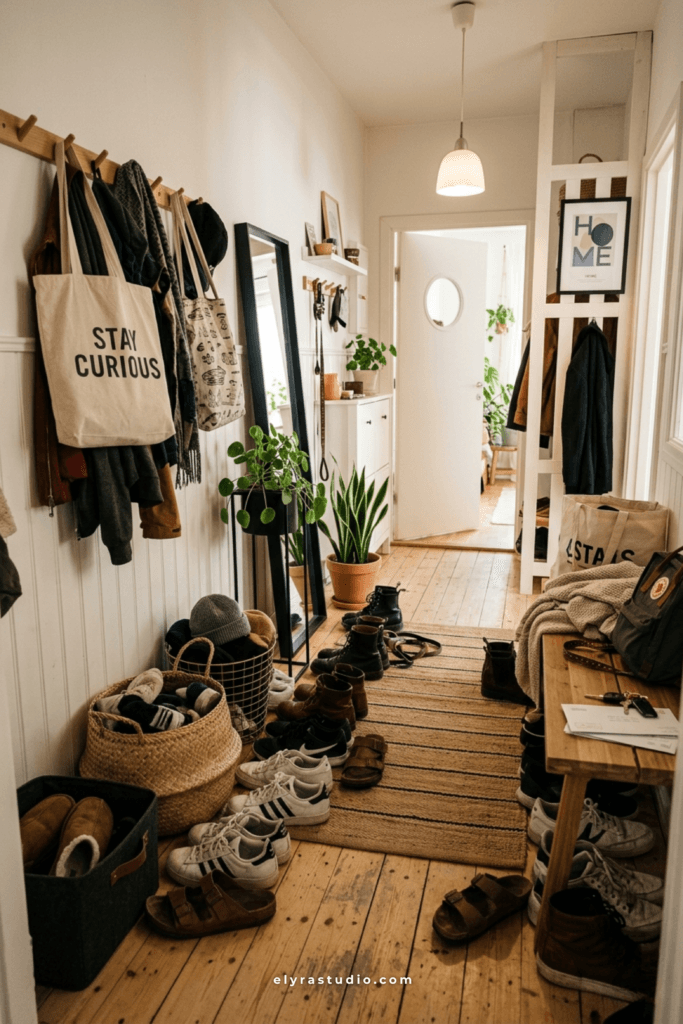
Think about a typical entryway.
There is a shoe rack, a tote bag, a basket, a pair of boots, and maybe a small bench.
Nothing is technically messy.
But the moment you walk in, the apartment already feels crowded.
Now imagine replacing the open shoe rack with a narrow closed shoe cabinet and moving the bags onto hooks.
Suddenly, the entry feels calmer.
You can see more of the floor.
The doorway feels easier.
The apartment has not changed size, but visually it feels lighter.
This is one of my favorite small-space shifts because it does not require a big makeover. It simply gives the room back some breathing room.
Quick tip: In a small apartment, the more floor you can see, the larger the space usually feels.
3. Bulky Furniture With No Breathing Room
Not all furniture takes up space in the same way.
Some pieces feel visually light.
Others feel heavy before you even sit on them.
A thick sofa.
A chunky coffee table.
A deep TV stand.
A large armchair.
A heavy bed frame.
A tall dresser.
One bulky piece can be fine. Sometimes it can even anchor the room beautifully.
The problem starts when every main piece feels heavy.
That is when a small apartment begins to feel full before you have even added decor.
This does not mean you need tiny furniture. Actually, too many tiny pieces can make a room feel even busier.
The goal is not to make everything small.
The goal is to make the room feel lighter.
What usually works better
Look for furniture with:
- raised legs
- slim arms
- open bases
- rounded edges
- simple shapes
- hidden storage
- lighter finishes
- glass or acrylic details
I always notice how much airier a small room feels when furniture has visible space underneath it.
A sofa with legs usually feels lighter than one that sits directly on the floor.
A glass coffee table feels lighter than a solid block table.
A slim media console feels calmer than a deep cabinet packed with visible items.
The small-space fix
Choose one heavy piece and balance it with something lighter.
If the sofa is bulky, keep the coffee table slim.
If the bed frame is heavy, use lighter nightstands.
If the TV stand is deep, avoid adding another large storage unit beside it.
Transparent materials can be surprisingly helpful here.
A glass coffee table, acrylic side table, or ghost-style chair can give you function without visually filling the room.
You do not need a full apartment of clear furniture. One lighter piece can be enough to make the whole space feel less crowded.
Think about two coffee tables.
One is a solid wood cube.
The other has a glass top and slim legs.
They may use almost the same amount of physical floor space.
But one stops your eye.
The other lets your eye travel through it.
That small difference can make a room feel much more open.
Quick tip: If one piece of furniture feels visually heavy, balance it with something lighter nearby.
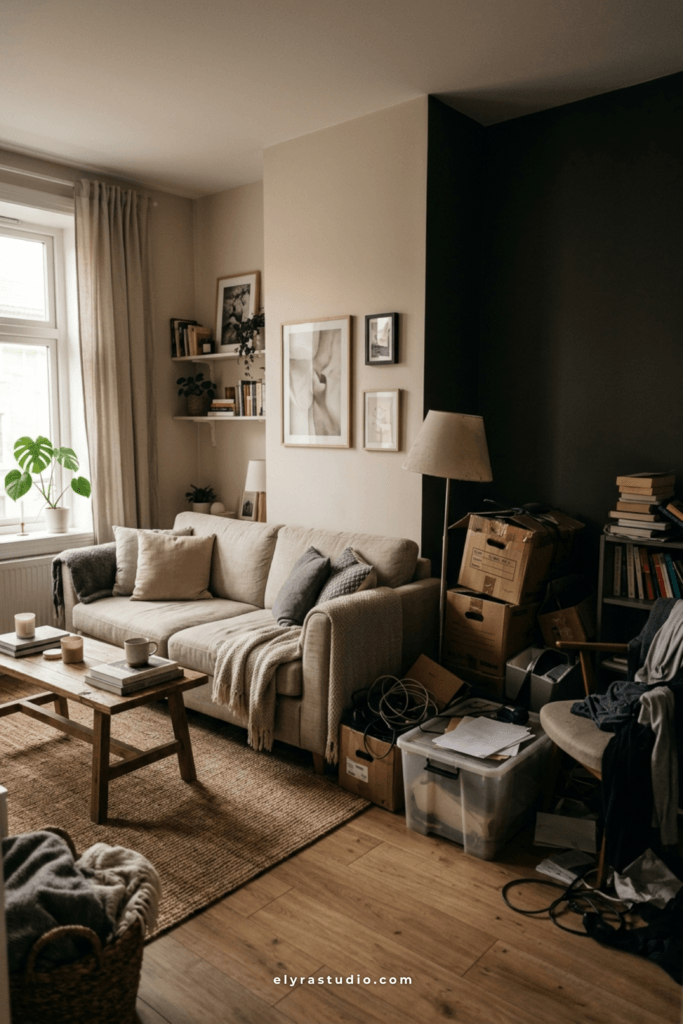
4. Storage That Looks Like Storage
Storage is supposed to help.
But in small apartments, storage can easily become part of the problem.
Open bins.
Plastic drawers.
Visible boxes.
Overfilled carts.
Random baskets.
Packed shelves.
Everything may be organized, but the room still feels busy.
This is where I think people get frustrated. They buy more organizers, sort everything into containers, and still feel like the apartment looks cluttered.
The problem is not always the amount of stuff.
Sometimes it is how much of it you can see.
Why visual noise matters
Visual noise is all the little things your eyes have to process at once.
Labels.
Bottles.
Shoes.
Cords.
Open baskets.
Colorful packaging.
Stacks of folded things.
Tiny objects on shelves.
Even when everything is technically clean, too many visible items can make a room feel unfinished.
You probably know the feeling.
You walk into a space, and nothing is truly dirty, but your mind still feels busy.
That is why closed storage can feel so calming.
The apartment has not gotten bigger.
But your eyes no longer have to work so hard.
The small-space fix
Look at your storage from across the room.
Not up close while organizing.
Step back and ask:
Does this make the room feel calmer or busier?
If the answer is busier, try switching to closed storage.
A closed cabinet will usually look calmer than open shelves full of products.
Matching baskets will usually feel more polished than five different containers.
A storage ottoman can hide blankets better than a pile on a chair.
A slim cabinet can calm a bathroom faster than another open cart.
Think about a bathroom with open shelves.
Every skincare bottle, hair product, towel, and extra item is visible.
It may be organized, but the room still feels crowded.
Move the same products into a closed cabinet or matching baskets, and suddenly the bathroom feels more peaceful.
Nothing major changed.
The visual noise just got quieter.
In my experience, this often works better than buying another organizer.
Because most homes do not need more storage sitting out.
They need storage that disappears.
Quick tip: If your storage makes the room look busier, it is not really solving the problem.
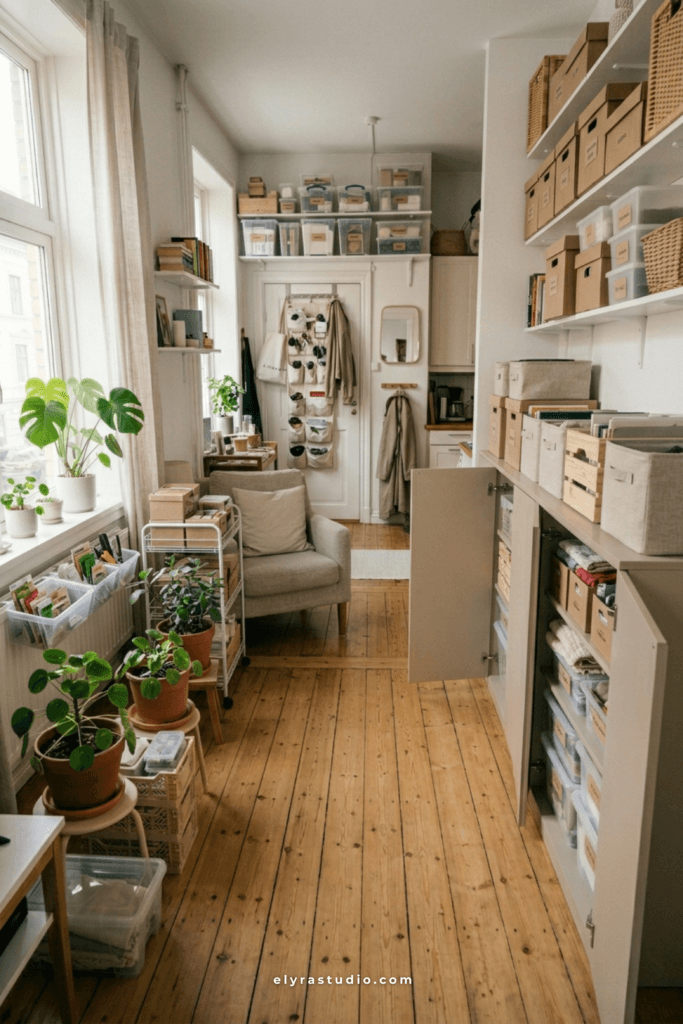
5. Dark Corners That Make The Room Feel Closed In
Lighting changes everything in a small apartment.
A room can be clean, organized, and beautifully decorated, but if the corners are dark, the whole space can feel smaller.
Dark corners make walls feel closer.
They make a room feel unfinished.
They create a closed-in feeling, especially at night.
This is one of those things that people often do not notice immediately. They just know the room feels a little flat, a little cold, or a little smaller than it should.
A single ceiling light rarely solves this.
It usually lights the center of the room and leaves the edges in shadow.
The result is a space that feels bright in the wrong place and dark everywhere else.
The small-space fix
Add light at different heights.
A floor lamp in a corner.
A table lamp on a console.
A small lamp on a shelf.
A plug-in wall sconce beside the bed.
A rechargeable lamp on a kitchen counter.
These small lights help your eye move around the room.
And when your eye can travel into the corners, the room feels deeper.
I always think small apartments look better with layered lighting instead of one bright ceiling light.
It feels softer.
More expensive.
More lived-in.
More intentional.
Think about a studio apartment where the bed corner always feels dark and separate.
Add one warm lamp beside the bed, and suddenly that corner becomes part of the room.
The walls did not move.
But the apartment feels larger because the dark edge disappeared.
This is such a small change, but it can completely shift the mood of the space.
Quick tip: A small apartment usually needs more than one light source. Try lighting the corners, not just the center.
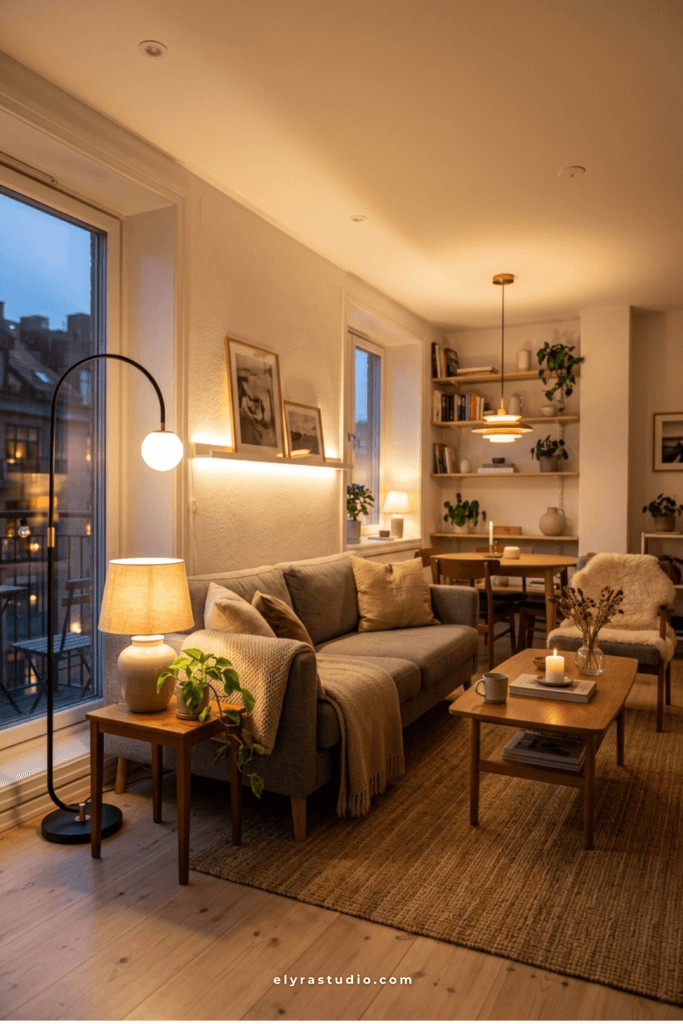
6. Rugs That Are Too Small
People often assume a small room needs a small rug.
But a tiny rug can actually make a room feel smaller.
This happens all the time in living rooms and bedrooms.
A small rug floats under the coffee table.
The sofa does not touch it.
The chair does not touch it.
The whole seating area feels disconnected.
Instead of making the room feel cozy, the rug visually chops the space into smaller pieces.
A larger rug usually does the opposite.
It connects the furniture.
It creates one clear zone.
It makes the room feel more intentional.
This is especially useful in studio apartments, where one room has to do several jobs.
A rug can help define the living area without adding walls or bulky dividers.
The small-space fix
Choose a rug that connects the main furniture pieces.
In a living room, try to have at least the front legs of the sofa and chairs touching the rug.
In a bedroom, let the rug extend beyond the sides of the bed.
In a studio apartment, use rugs to create zones without making the room feel divided into tiny pieces.
Think about a small living room with a tiny rug under only the coffee table.
The sofa, chair, and table all feel separate.
Now imagine a larger rug that reaches under the front legs of the sofa and chair.
Suddenly everything feels like one cozy, finished area.
The room did not get more square footage.
But it feels more pulled together.
I love this change because it often makes a small space feel more polished without adding more decor.
Sometimes the room does not need more things.
It just needs the right foundation.
Quick tip: A rug should connect the room, not float like a small island.
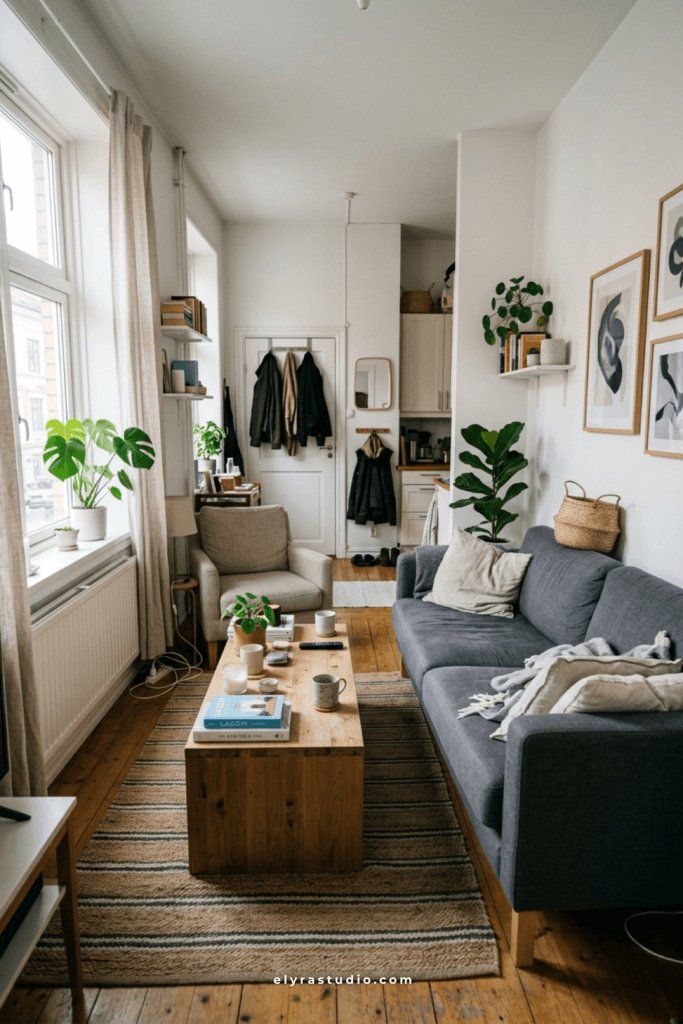
7. Too Much Visual Clutter On Open Surfaces
Small apartments can feel cramped even when they are not messy.
Usually, it is because too many surfaces are carrying too many small things.
The coffee table.
The kitchen counter.
The bathroom vanity.
The nightstand.
The TV console.
The entry table.
A candle.
A book.
A charger.
A cup.
A remote.
A perfume bottle.
A plant.
A hair clip.
A letter.
None of these things feels like a disaster.
But together, they create constant visual activity.
This is why a room can be clean but still feel cluttered.
I used to think the answer was better styling. But sometimes the best styling trick is simply removing half of what is sitting out.
The small-space fix
Choose one surface and simplify it.
Start with the one you see most often.
Clear it completely.
Then add back only what feels useful or beautiful.
A tray can help.
A closed box can help.
A drawer organizer can help.
But the real trick is giving every surface a purpose.
The coffee table does not need to hold everything.
The nightstand does not need to become a mini storage unit.
The bathroom counter does not need every product you use.
Think about a kitchen counter with appliances, mail, vitamins, keys, and a water bottle all sitting out.
Nothing is truly messy.
But the room feels full.
Clear most of it away, and the whole kitchen suddenly feels lighter.
This is one of those changes that makes a bigger difference than expected.
When surfaces are calmer, the apartment feels calmer.
And a calmer apartment almost always feels bigger.
Quick tip: Empty space on a counter or table is not wasted space. It is visual breathing room.
8. Curtains Hung Too Low Or Too Narrow
Curtains can completely change the way a small apartment feels.
But when they are hung too low or too close to the window frame, they can make the room feel shorter and more boxed in.
This mistake is so common.
The curtain rod sits just above the window.
The panels cover part of the glass.
The window looks smaller than it really is.
And because windows bring in light, making them look smaller can make the whole room feel smaller too.
The small-space fix
Hang curtains higher and wider.
Place the curtain rod closer to the ceiling, or at least several inches above the window frame.
Extend the rod wider than the window so the curtains can sit outside the glass when open.
This makes the window look larger.
It makes the ceiling feel higher.
And it gives the whole room a softer, more expensive look.
I love this trick because it can make basic curtains look more intentional.
You do not need luxury fabric.
You just need better placement.
The tone-on-tone trick
If your curtains are close to the color of your walls, they blend in softly instead of creating a harsh visual frame.
This works beautifully in small spaces because the wall feels less interrupted.
The room feels calmer.
The window feels larger.
The whole space feels more open.
Think about a bedroom with a small window and short curtains.
The wall feels cut off.
Now hang the curtains higher and wider, using a soft color close to the wall.
Suddenly the window feels elegant instead of small.
Quick tip: Curtains should make the window feel bigger, not outline how small it is.
9. Mirrors That Reflect The Wrong Thing
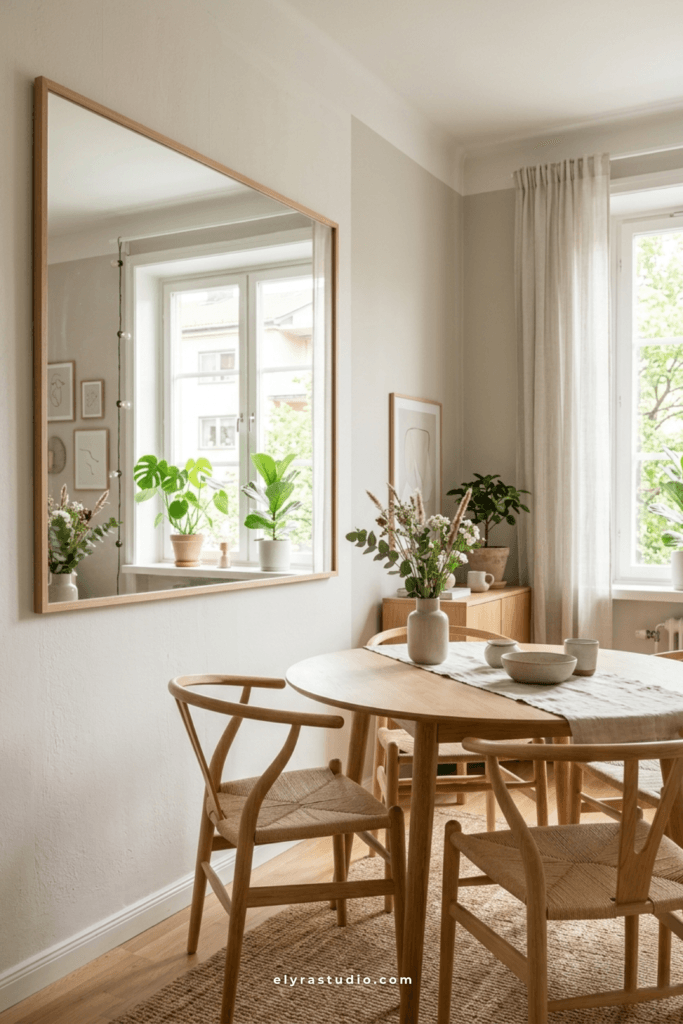
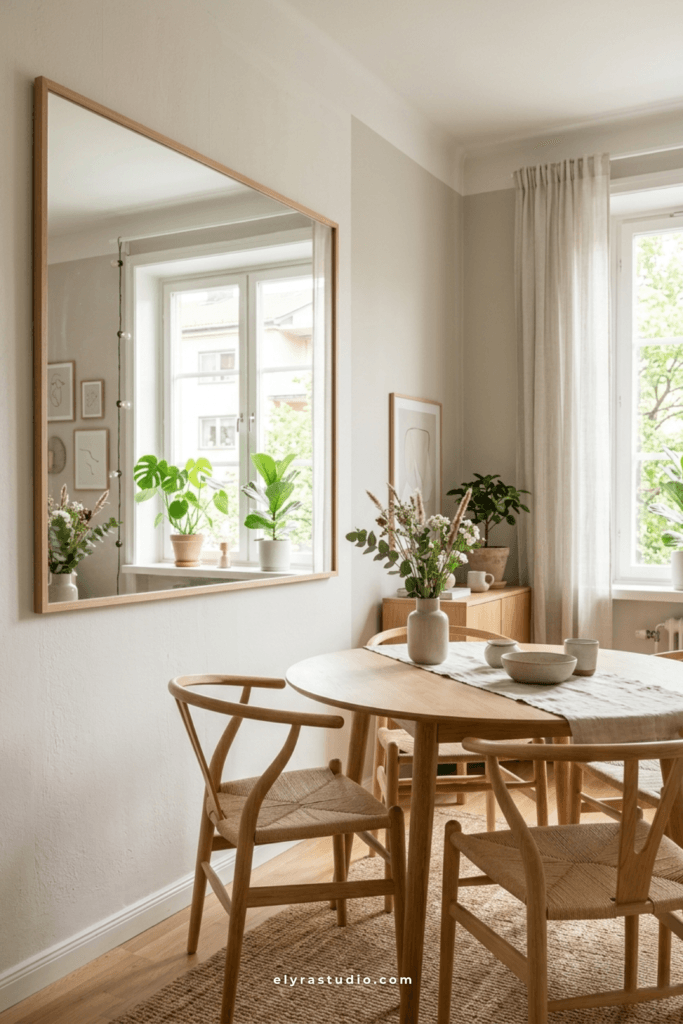
Mirrors can make a small apartment feel larger.
But only when they are placed thoughtfully.
A mirror is not magic on its own.
If it reflects clutter, it doubles clutter.
If it reflects a dark corner, it doubles darkness.
If it reflects a busy shelf, it doubles visual noise.
But if it reflects light, a window, a lamp, or an open part of the room, it can make the apartment feel brighter and deeper.
This is one of my favorite small-space tricks because it works without adding more furniture.
A mirror can create a sense of space while taking up almost no floor area.
The small-space fix
Before hanging a mirror, stand where it will go and look at what it would reflect.
Ask yourself:
Will this reflect light?
Will this reflect something calm?
Will this make the room feel deeper?
A mirror across from or near a window usually works beautifully because it bounces light around the room.
A mirror near a lamp can make the room feel warmer at night.
A mirror reflecting a clean, open area can create the feeling of more depth.
But a mirror facing a messy open shelf may only make the room feel twice as busy.
Think about a narrow entryway.
A mirror placed opposite clutter can make the entry feel chaotic.
But a mirror placed where it catches light from the living room can make the whole area feel brighter and more open.
The mirror did not create real space.
It created visual depth.
And sometimes that is exactly what a small apartment needs.
Quick tip: A mirror should reflect the prettiest or brightest part of the room, not the messiest.
10. Decor That Does Not Have A Clear Style Direction
This one is subtle, but it matters.
A small apartment can start to feel smaller when every corner has a different style.
A little farmhouse.
A little glam.
A little modern.
A little boho.
A few random colors.
Several different wood tones.
Some trendy pieces.
Some leftover furniture.
Some decor you bought because it was cute, but it does not really connect to anything else.
This happens so easily, especially when you decorate slowly over time.
And honestly, most people do decorate this way.
You buy a lamp one month.
A pillow later.
A basket because it is on sale.
A print because it looks cute.
None of it is wrong.
But in a small apartment, mixed signals feel louder.
The apartment may not be cluttered, but it feels visually scattered.
The small-space fix
Choose a feeling before choosing more decor.
Not a strict theme.
Just a clearer mood.
Maybe you want your apartment to feel:
- calm
- warm
- cozy
- minimal
- earthy
- soft
- romantic
- modern
- airy
- Scandinavian
Once you know the feeling, decisions become easier.
You can repeat similar colors.
Keep wood tones closer.
Use matching metals.
Choose storage pieces that belong in the same world.
Pick pillows, rugs, lamps, and decor that support the same mood.
I always think a small apartment feels bigger when the style feels connected.
Not perfect.
Just connected.
Think about a room with a black metal shelf, rustic wood table, glam gold mirror, bright blue pillows, farmhouse baskets, and modern lamps.
Each piece might be nice alone.
Together, they compete.
Now imagine soft neutrals, warm wood, simple black accents, and textured baskets repeated throughout the room.
Suddenly the apartment feels calmer.
Nothing dramatic happened.
The room simply started speaking one language.
Quick tip: A small apartment does not need a strict theme, but it does need a clear mood.
11. Not Leaving Enough Empty Space
This might be the most overlooked reason a small apartment feels smaller than it really is.
We often assume beautiful spaces are created by adding.
Another basket.
Another shelf.
Another print.
Another plant.
Another organizer.
Another decorative tray.
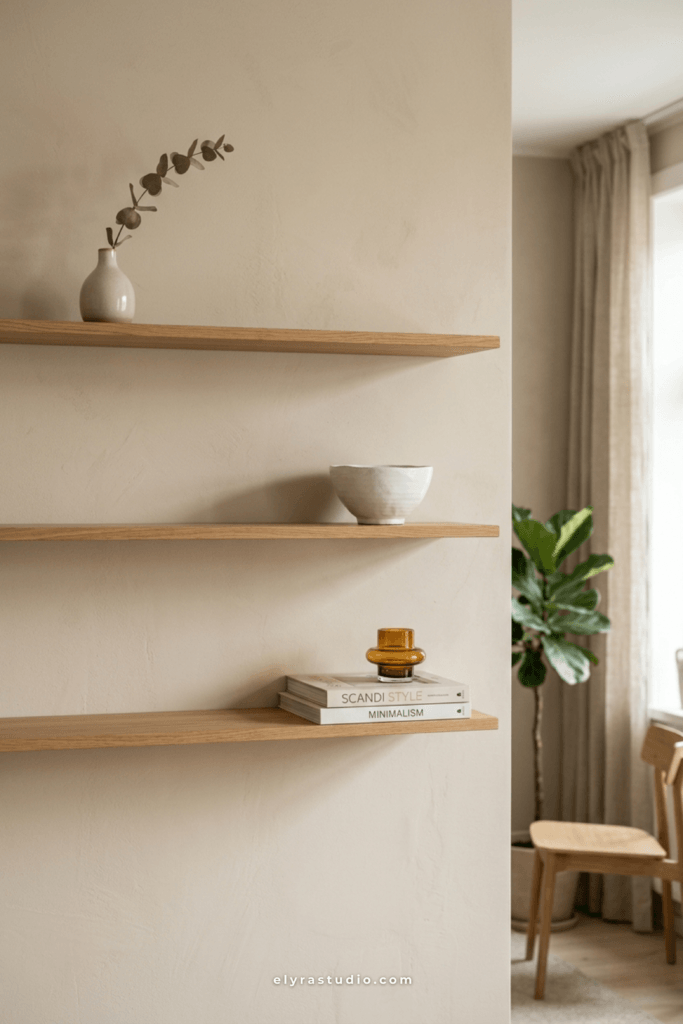
But some of the calmest rooms feel beautiful because they leave room to breathe.
An empty corner is not wasted space.
A clear shelf is not unfinished.
A blank section of wall does not always need art.
A coffee table does not need to be fully styled.
This is sometimes called negative space, but I like to think of it as breathing room.
Small apartments need breathing room just as much as they need storage.
Why breathing room matters
When every surface is full, your eye has nowhere to rest.
Everything competes for attention.
Even pretty things start to feel like clutter when there are too many of them.
But when there is space around an object, it looks more intentional.
A lamp looks more elegant.
A vase looks more special.
A chair looks more sculptural.
A shelf looks more styled.
I always notice how much more expensive a room feels after removing a few things rather than adding more.
The small-space fix
Choose one area where you can leave something empty on purpose.
It could be:
- one clear section of a shelf
- one empty corner
- one side of the coffee table
- one wall without extra decor
- one nightstand with only a lamp and book
Think about a shelf packed with candles, books, frames, plants, and baskets.
Everything may be cute, but nothing stands out.
Remove a few pieces and leave some open space.
Suddenly the remaining decor looks more intentional.
The room feels calmer.
Larger.
More polished.
You do not need more decor.
You may need less.
And that can feel surprisingly freeing.
Quick tip: Empty space is what makes your favorite pieces look intentional.
Quick Small Apartment Check
Before buying anything new, take a slow look around your apartment and ask yourself these questions.
This is the kind of little checklist I would save on my phone before rearranging a small space.
Floor Space
☐ Can I see most of the floor?
☐ Are there items sitting on the floor that could live somewhere else?
☐ Does the room feel easy to walk through?
☐ Do I have to squeeze around any furniture every day?
Visual Clutter
☐ Do open shelves look calm or busy?
☐ Are countertops carrying more than they need to?
☐ Is there one surface I could simplify today?
☐ Does my storage hide clutter or display it?
Lighting
☐ Is there a dark corner making the room feel smaller?
☐ Do I have light at different heights, not just one ceiling light?
☐ Does the room feel warm and soft in the evening?
☐ Could one small lamp change the mood of the space?
Furniture & Layout
☐ Is any furniture blocking the natural path through the room?
☐ Does the layout feel open or crowded?
☐ Is there one bulky piece making the room feel heavier?
☐ Could I move one item a few inches and improve the flow?
Windows & Mirrors
☐ Do my curtains make the window feel larger or smaller?
☐ Could my curtains be hung higher or wider?
☐ Are my mirrors reflecting light or clutter?
☐ Is the brightest part of the room being used well?
Breathing Room
☐ Is there enough empty space between objects?
☐ Does every shelf need everything currently on it?
☐ Could removing one thing improve the room more than adding one thing?
☐ Is there a place where my eye can rest?
If you answered “no” to several of these, do not worry.
You probably do not need a bigger apartment.
You may simply need less visual noise, better flow, and a few calmer choices.
Small apartments often feel larger when we edit, simplify, and create breathing room instead of adding more furniture, storage, or decor.
A Simple 7-Day Small Apartment Reset
If your apartment has been feeling cramped, do not try to fix everything at once.
That usually makes the process feel overwhelming.
Small spaces often improve best through small, intentional changes.
Here is a simple 7-day reset you can do without renovating or buying a lot of new things.
Day 1: Clear The Floor
Walk through your apartment and look only at the floor.
Move anything that does not truly need to sit there.
Bags.
Baskets.
Shoes.
Boxes.
Extra decor.
Random storage bins.
The goal is not perfection.
The goal is to make the room feel easier to move through.
Even one clearer walkway can change the feeling of the space.
Day 2: Hide One Category Of Clutter
Choose one category that always makes your apartment feel messy.
Shoes.
Beauty products.
Mail.
Chargers.
Cleaning supplies.
Pet items.
Workout things.
Find one closed or calmer home for that category.
This is the day to reduce visual noise.
Not everything needs to disappear.
But one busy category should become less visible.
Day 3: Light One Dark Corner
Pick the darkest corner in your apartment and add one warm light source.
A floor lamp.
A table lamp.
A plug-in wall sconce.
A rechargeable lamp.
A small lamp on a shelf.
This one change can make the room feel softer almost immediately.
I would always rather add one warm corner lamp than rely only on harsh overhead lighting.
It changes the entire mood.
Day 4: Simplify One Surface
Choose one surface you see every day.
The coffee table.
The bathroom counter.
The kitchen counter.
The nightstand.
The entry table.
Clear it completely.
Then add back only what feels useful, beautiful, or calming.
This is one of the quickest ways to make a small apartment feel more peaceful.
Day 5: Check Your Curtains And Mirrors
Look at your curtains first.
Could they be higher?
Could they be wider?
Could they blend more softly with the wall?
Then look at your mirrors.
Are they reflecting light and space, or are they reflecting clutter?
Move one thing if it makes the room feel better.
This day is about making the apartment feel brighter and taller without changing the actual room.
Day 6: Create More Breathing Room
Choose one shelf, corner, table, or wall and remove something.
Leave a little empty space on purpose.
This may feel unfinished at first.
Give it a day.
Often, this is the change that makes the whole apartment feel more polished.
The goal is not emptiness.
The goal is calm.
Day 7: Rearrange For Better Flow
Walk through your apartment like a guest entering for the first time.
Where does the room feel tight?
Where do you have to squeeze?
What blocks the natural path?
Move one piece of furniture, even slightly.
Sometimes a few inches can change the feeling of the whole room.
This is not about creating a perfect layout.
It is about making the apartment easier to live in.
Final Thoughts
If your apartment feels smaller than it really is, it does not mean you have failed at decorating.
Small spaces are sensitive.
Every piece matters a little more.
Every surface shows a little more.
Every dark corner, bulky chair, tiny rug, and visible storage bin has a bigger effect than it would in a larger home.
But that also means small changes can make a surprisingly big difference.
You do not need a renovation.
You do not need expensive furniture.
You do not need to start over.
Start with the things that make the room feel heavy.
Clear the floor.
Soften the lighting.
Hide the visual clutter.
Let the windows feel larger.
Use mirrors carefully.
Leave more breathing room.
Choose furniture that feels lighter.
Create a clearer path through the space.
Your apartment may not need to be bigger.
It may just need to feel calmer, lighter, and easier to live in.
And you are probably closer to that feeling than you think.