You know that feeling when your bedroom is technically clean… but the space still feels mentally heavy?
Nothing is obviously wrong.
The bed is made.
The laundry is gone.
The surfaces are mostly clear.
And yet, when you walk in, your brain does not soften.
It switches on.
You start noticing the chair in the corner, the cable beside the bed, the slightly crowded nightstand, the light that feels too harsh, the bedding that somehow looks heavier than it should.
This is why small bedrooms rarely feel stressful because of their actual size.
They feel stressful because of micro-friction.
Too many things are visible at once.
Too many sharp shifts in color, texture, and shape.
Too many small decisions your brain keeps processing in the background.
A calm bedroom is not created by decorating more.
It is created by removing resistance.
Less visual noise.
Less clutter to interpret.
Less furniture to move around.
Less contrast pulling your eye in every direction.
The goal is not to make the room empty.
The goal is to make it feel easier to breathe in.
Luxury, especially in a small bedroom, rarely comes from expensive furniture. It comes from visual simplicity, soft texture, warm lighting, and a quiet structure that makes the whole room feel intentional.
These small bedroom ideas are about creating that feeling.
A room that feels calm instead of crowded.
Soft instead of busy.
Luxurious without trying too hard.
1. Start With Visual Silence, Not Decoration
Small Bedroom Ideas That Feel Calm Instead of Crowded
The Problem
Many small bedrooms feel visually loud before they are even truly full.
It does not always come from obvious mess.
Sometimes it comes from too many small contrasts:
a dark bedside table against a pale wall, a busy rug, mismatched pillows, exposed cables, decorative objects on every surface, and no clear place for the eye to rest.
The room may be clean.
But it still feels like it is asking for attention.
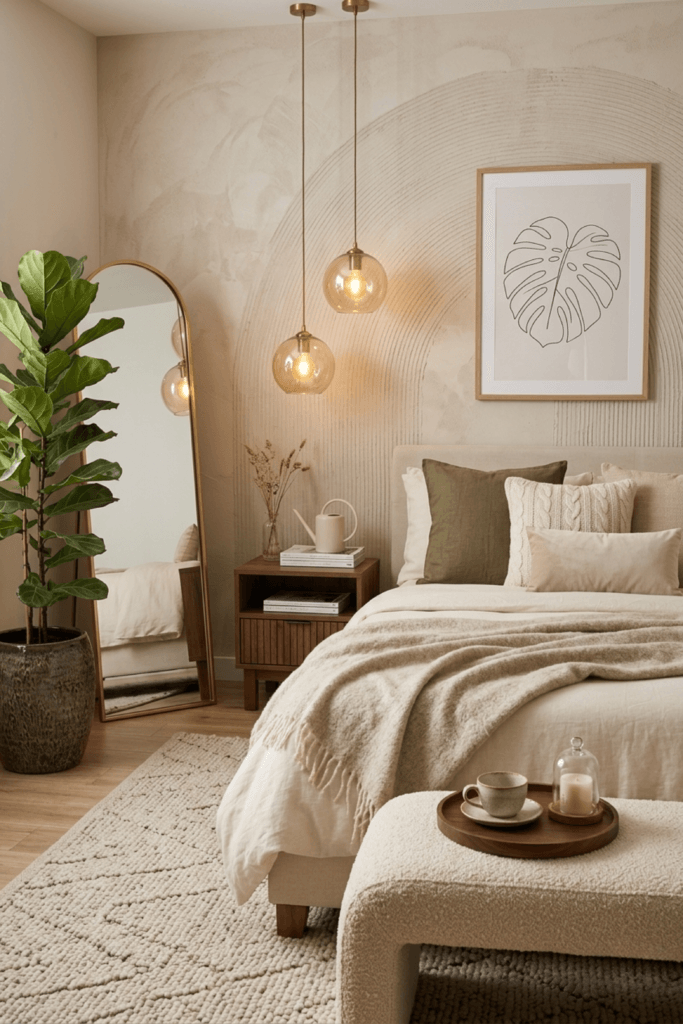
In the first image, the room feels calm because it does not rely on more furniture to create interest. The subtle wall texture behind the bed adds depth without adding clutter. The floor-length arched mirror brings height, reflection, and softness without taking over the room.
That is the difference.
Character is added through quiet surfaces, not visual noise.
The Shift
Instead of asking:
“What else should I add?”
Ask:
“What can the room stop saying?”
A small bedroom does not need every corner to be styled. It needs fewer visual interruptions.
Visual silence does not mean plain or boring. It means the room has enough restraint that the beautiful details can actually be noticed.
The texture on the wall.
The soft bedding.
The curve of the mirror.
The warmth of the wood.
The empty space around the bed.
These are the details that make a room feel luxurious because they are not fighting each other.
Why It Works
Your brain relaxes faster when the room gives it fewer things to process.
A calm color palette softens the boundaries of the space. Repeated natural textures make the room feel connected. Curved forms, like an arched mirror or rounded decor, reduce harshness and make the space feel less rigid.
The room starts to feel quieter before you even know why.
That is visual silence.
Not emptiness.
Just less tension.
Quick Application
Choose one dominant palette for the whole room.
For example:
- warm white
- soft beige
- light taupe
- muted sage
- natural wood
- cream textiles
Then remove anything that creates a sharp visual interruption without serving a clear purpose.
Leave at least one surface partially empty.
A small bedroom feels more expensive when it has space to pause.
2. Add Character Through Texture, Not Clutter
Calm Bedroom Decor That Still Feels Personal
The Problem
A small bedroom can easily become too plain when you remove clutter.
This is where many people panic.
They simplify the room, then it starts to feel unfinished, so they add more decor back in:
more candles, more prints, more trays, more small objects.
And suddenly, the calm disappears again.
The problem is not personality.
The problem is adding personality through too many small things.
The Shift
Use texture as decoration.
Texture adds depth without demanding the same level of attention as objects.
A plaster-effect wall, soft linen bedding, a woven rug, a boucle bench, a ceramic lamp, or a natural wood nightstand can make the room feel layered without crowding it.
This is especially important in small bedrooms because every object sits close to the eye.
Too many tiny details feel busy quickly.
Large, quiet textures feel more elegant.
Why It Works
Texture gives the room emotional warmth.
It makes a neutral space feel finished without needing strong color or heavy decoration.
A textured wall behind the bed can replace a busy gallery wall. A soft rug can make the room feel warmer without adding another furniture piece. Linen curtains can soften the window without visually shrinking the space.
This is how a room becomes calm but not empty.
Simple but not cold.
Minimal but not flat.
Quick Application
Choose three texture zones:
- One soft textile texture
- One natural material texture
- One subtle wall or surface texture
For example:
- linen bedding
- wood nightstand
- textured plaster wall
That is enough.
The room does not need ten different finishes to feel interesting.
It needs a few quiet ones repeated well.
3. Layer Softness Instead of Adding More Furniture
Cozy Bedroom Ideas That Feel Soft, Not Heavy
The Problem
A lot of small bedrooms try to feel luxurious by adding more furniture.
A bench at the end of the bed.
A vanity table.
A second dresser.
A reading chair.
Extra shelving.
More decor to make the space feel “finished.”
But in a small room, more furniture often creates more friction.
You start walking around pieces instead of moving freely.
The room becomes something you navigate, not something you rest in.
The Shift
Instead of increasing quantity, increase softness.
In the second image, the luxury does not come from the number of objects. It comes from warmth, lighting, texture, and built-in details.
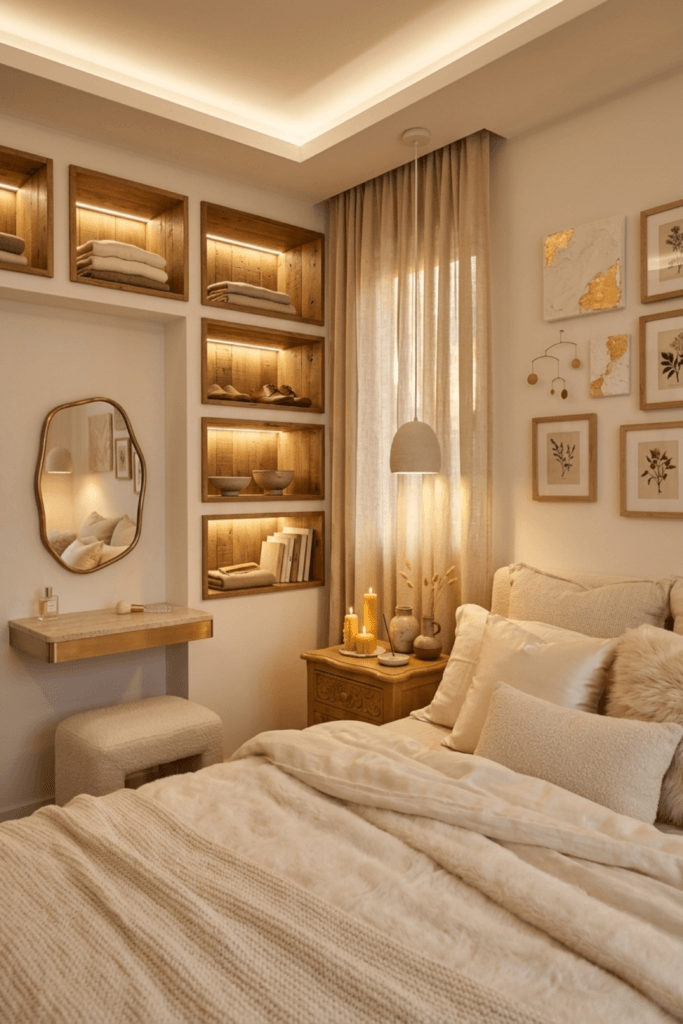
The recessed ceiling lighting creates a soft glow instead of a harsh overhead glare. The wooden wall niches add storage and depth without pushing bulky furniture into the room. The warm LED lighting inside the niches highlights the wood grain and folded textiles, making everyday storage feel intentional.
That is the key.
The storage is doing work, but it does not feel like storage.
It feels like atmosphere.
Why It Works
Softness reduces visual pressure.
A bedroom should not feel like a showroom packed with features. It should feel like a place where the body can slow down.
Layered bedding, warm lighting, soft curtains, and rounded edges all help remove the sharpness from a small room.
This matters because small bedrooms are intimate spaces. Your eyes are close to every surface. Harsh light, sharp contrast, and too many hard edges feel stronger here than they would in a larger room.
Softness is not just aesthetic.
It changes how the room feels in your body.
Quick Application
Use fewer furniture pieces, but make the soft layers more intentional.
Try:
- one textured throw
- two to four pillows maximum
- warm bedside lighting
- full-length curtains
- a soft rug under or beside the bed
- one natural material, repeated quietly
Avoid filling the room with too many “cozy” objects.
Cozy becomes cluttered when every object tries to create the feeling.
Let texture and light do most of the work.
4. Use Built-In Details to Make Storage Feel Invisible
Small Bedroom Storage Ideas That Still Feel Luxurious
The Problem
Storage can quickly become visually aggressive in a small bedroom.
Open shelves get crowded.
Dressers feel too bulky.
Baskets multiply.
Hooks become overloaded.
Everything that was meant to solve clutter starts becoming part of the clutter.
The room may technically have more storage.
But it does not feel calmer.
It feels more full.
The Shift
The best small bedroom storage does not shout.
It blends in.
Built-in shelves, recessed niches, under-bed storage, closed wardrobes, and wall-to-wall solutions work because they reduce the number of separate objects your eye has to process.
Instead of seeing five storage pieces, your eye reads one calm structure.
This is why built-ins often feel more expensive.
Not because they are always more elaborate.
But because they reduce visual fragmentation.
Why It Works
Every separate furniture piece creates a visual edge.
In a small bedroom, too many edges make the room feel chopped up.
Integrated storage creates continuity. It allows the walls to keep feeling like walls instead of becoming a collection of furniture pieces.
The space feels smoother.
Less interrupted.
More intentional.
Quick Application
Look at your bedroom storage and ask:
“Does this piece calm the room, or does it add another visual stop?”
Then simplify one storage zone.
You might:
- use matching closed boxes on one shelf
- move seasonal items under the bed
- clear open shelving by half
- replace several small baskets with one larger closed container
- keep only the most beautiful or useful items visible
Visible storage should be edited harder than hidden storage.
If the eye can see it, the brain has to process it.
5. Make the Bed the Quiet Center of the Room
How to Make a Small Bedroom Feel More Expensive
The Problem
Many small bedrooms feel chaotic because there is no clear visual anchor.
The eye jumps from the bed to the window, from the wall art to the nightstand, from the rug to the wardrobe, from the lamp to the cluttered surface.
Nothing is necessarily wrong.
But nothing is clearly leading the room either.
When everything has equal visual weight, the room feels unsettled.
The Shift
Let the bed become the quiet center.
Not loud.
Not overdecorated.
Just clearly important.
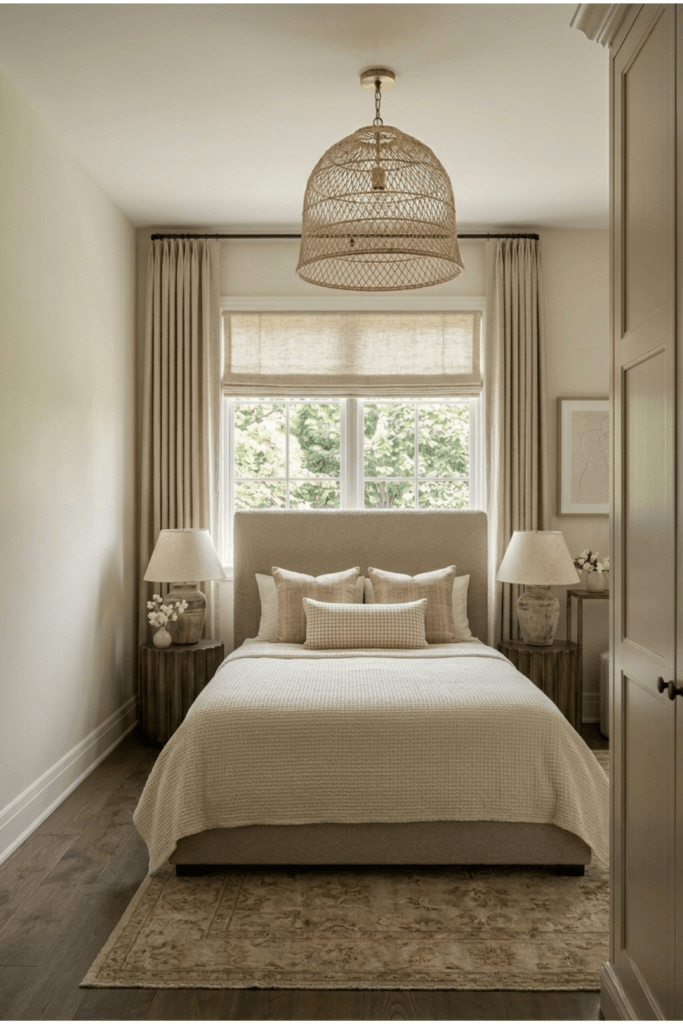
In the third image, the bed is framed by soft curtains, balanced bedside tables, and a large woven pendant. The palette is restrained, and the layout feels symmetrical enough to calm the eye.
This gives the room instant order.
The bed becomes the visual pause point.
Everything else supports it.
Why It Works
A clear focal point makes a small room easier to understand.
Your brain likes hierarchy.
When you walk into a bedroom and immediately understand where the main focus is, the room feels calmer. This is one reason hotel bedrooms often feel restful even when they are small.
The layout is predictable.
The bed is the anchor.
The lighting supports the bed.
The side tables support the bed.
The art and textiles do not compete for attention.
That predictability creates comfort.
Quick Application
Simplify the area around the bed first.
Try:
- matching or visually balanced nightstands
- similar lamp heights
- calm bedding
- one main wall feature behind the bed
- fewer decorative pillows
- clear space beside the bed if possible
You do not need perfect symmetry.
You need visual balance.
A small bedroom feels more luxurious when the bed looks intentional, not buried inside the room.
6. Create Flow in a Narrow Bedroom
Small Bedroom Layout Ideas That Reduce Friction
The Problem
Long, narrow bedrooms can feel especially difficult.
You may technically have enough space, but the room still feels awkward.
The walkway is tight.
Furniture sticks out.
Corners become clutter zones.
The bed dominates the floor.
Every movement feels slightly interrupted.
This is physical friction.
And physical friction quickly becomes mental friction.
The Shift
In a narrow bedroom, the goal is not to fit more in.
The goal is to make movement feel effortless.
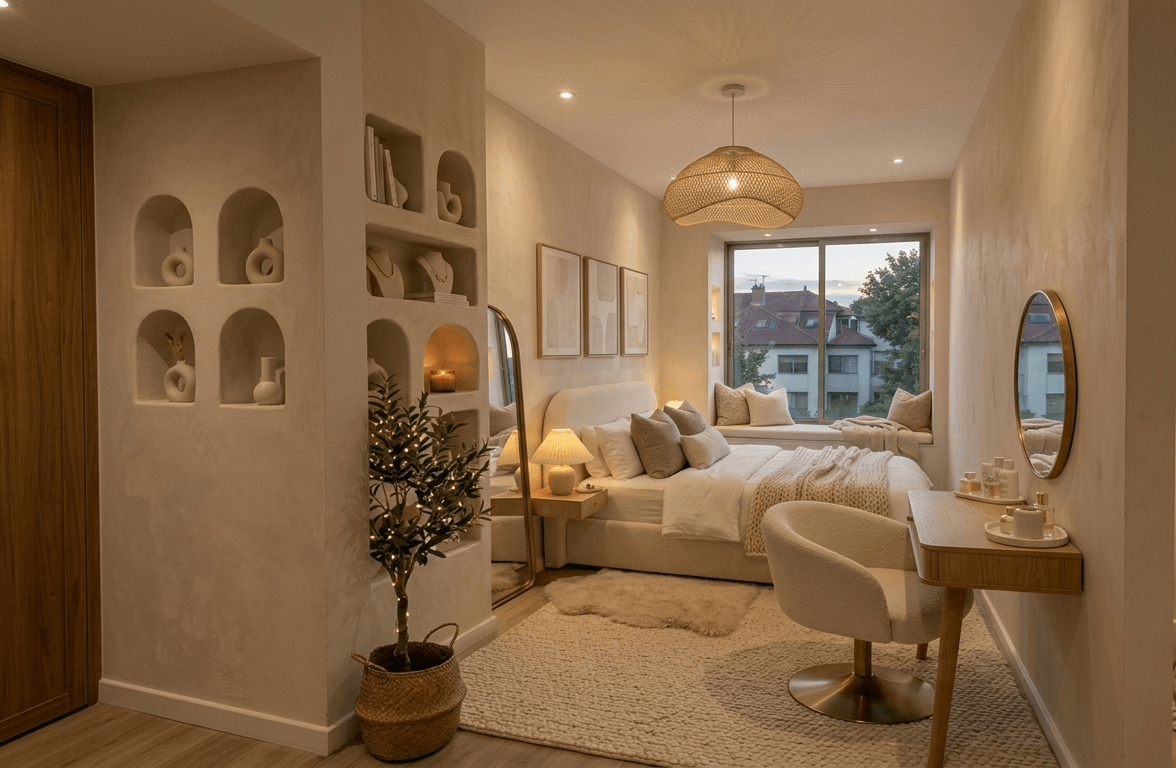
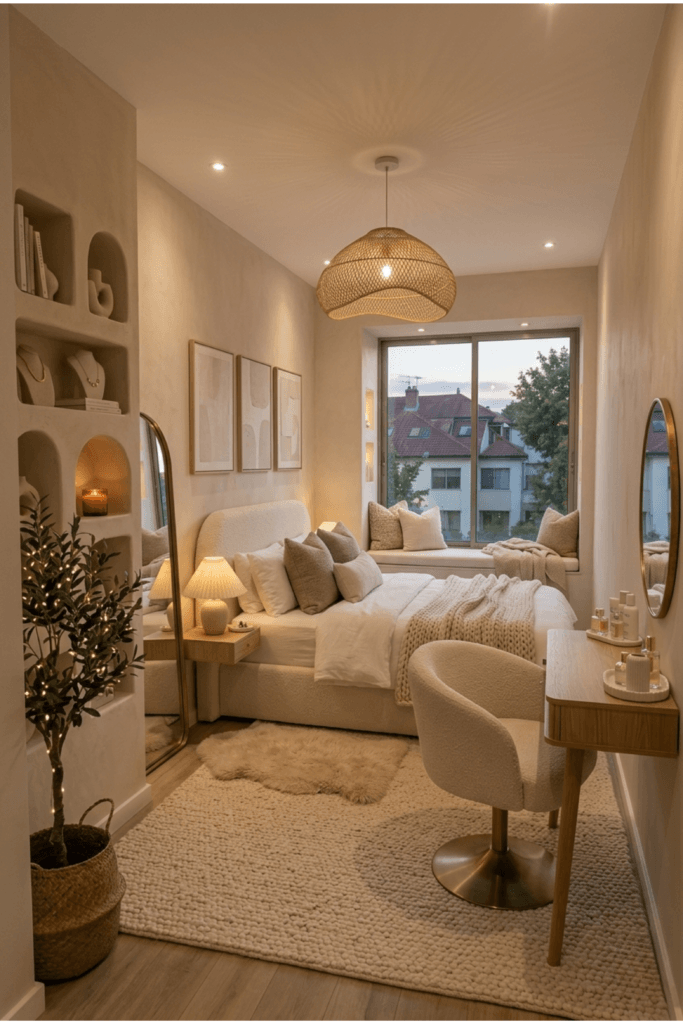
The fourth image shows this beautifully. The room is narrow, but it does not feel blocked. The furniture stays close to the walls. The organic wall niches add storage and display space without taking up floor area. The built-in window seat gives the room a soft destination point without placing another chair in the walking path.
Nothing feels like something you might bump into.
That is the feeling small bedrooms need.
Why It Works
A room feels calmer when the body can move through it without constant adjustment.
Even tiny interruptions matter:
walking around a chair,
squeezing past a dresser,
stepping over a basket,
avoiding a sharp corner.
These small movements teach your body that the room is inconvenient.
When the path is clear, the room feels more generous.
Even if the square footage has not changed.
Quick Application
Stand at the entrance of your bedroom and look at the first path your body takes.
Then ask:
“What is interrupting this path?”
It may be:
- a chair that is rarely used
- a basket on the floor
- a nightstand that is too wide
- a dresser placed too close to the bed
- decor that sticks out from the wall
Remove or slim down one obstacle.
In a small bedroom, better flow can feel more luxurious than more decor.
7. Reduce Micro-Clutter Before You Redecorate
The Real Reason Small Bedrooms Feel Mentally Heavy
The Problem
The biggest source of visual stress in a bedroom is often not the furniture.
It is micro-clutter.
The small things:
- charging cables
- skincare bottles
- water glasses
- receipts
- hair ties
- books stacked without intention
- clothes waiting to be put away
- random objects on the nightstand
- items sitting on the dresser “just for now”
Individually, they look harmless.
Together, they create constant visual noise.
This is why a bedroom can be clean and still feel heavy.
The Shift
Before you buy anything, edit what is already visible.
Do not start with styling.
Start with subtraction.
A calm bedroom is usually not the result of adding the perfect thing.
It is the result of removing the unnecessary things that were weakening the whole room.
Why It Works
Every visible category is a small mental task.
Skincare says “routine.”
Cables say “technology.”
Laundry says “unfinished task.”
Stacks of objects say “decision waiting.”
Your bedroom should not be filled with reminders.
It should help your nervous system step away from the day.
When you reduce visible categories, the room feels quieter immediately.
Quick Application
Choose one visible category today.
Only one.
For example:
- all visible cables
- everything on the nightstand
- items on the dresser
- objects on open shelves
- anything sitting on the floor
Put the unnecessary items in a box for three days.
Do not reorganize them immediately.
Just remove them from sight.
Then notice how the room feels.
Often, the room does not feel emptier.
It feels more expensive.
Because the space finally has composure.
8. Use Lighting to Melt Away Harshness
Bedroom Lighting Ideas That Feel Calm and Cozy
The Problem
One harsh ceiling light can make even a beautiful bedroom feel flat.
It removes softness.
It creates hard shadows.
It makes the room feel functional instead of restful.
A bedroom lit only from above often feels like a task space.
Not a retreat.
The Shift
Think in lighting layers.
A calm bedroom should not switch from dark to bright in one harsh step.
It should glow.
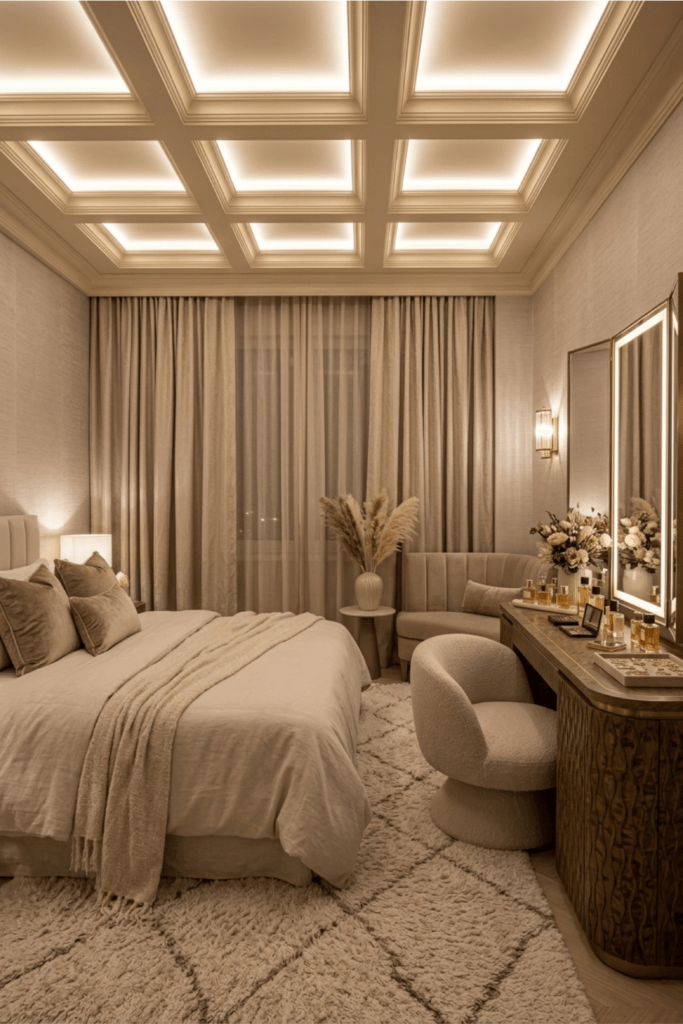
In the fifth image, the layered lighting creates warmth from multiple directions. The ceiling light is softened. The bedside glow is gentle. The mirror area adds depth. The curtains and rug absorb the brightness so the whole room feels warmer and more intimate.
This is how lighting changes the emotional temperature of a room.
Why It Works
Warm, indirect light reduces visual harshness.
It softens edges and makes textures feel richer. It gives the room depth instead of flattening everything under one bright fixture.
This is one of the easiest ways to make a small bedroom feel luxurious.
Not brighter.
Softer.
The room should feel like it is helping you slow down.
Quick Application
Use at least two lighting levels:
- one practical light
- one soft ambient light
If possible, add a third:
- a wall light
- a low lamp
- a small glow near a mirror
- indirect light near shelving or curtains
Keep the color temperature warm.
The goal is not maximum visibility.
The goal is atmosphere.
9. Stop Filling Every Empty Corner
Small Space Decor Ideas That Feel Intentional
The Problem
Small bedrooms often become crowded because every empty corner gets treated like a problem.
A blank wall needs art.
An empty corner needs a chair.
A clear surface needs a tray.
A window needs extra styling.
A floor gap needs a basket.
But empty space is not always unfinished.
Sometimes it is the reason the room works.
The Shift
Let some areas stay quiet.
A luxurious small bedroom needs negative space.
Not wasted space.
Recovery space.
A place where the eye does not have to do anything.
Why It Works
Negative space creates contrast.
Without it, even beautiful objects lose their power.
A textured wall looks better when it is not covered.
A mirror feels more elegant when it has breathing room.
A bed feels calmer when the surrounding surfaces are not crowded.
A shelf feels more intentional when it is not filled edge to edge.
The room becomes more confident.
It stops trying so hard.
Quick Application
Choose one area of the bedroom and leave it intentionally simple.
For example:
- one blank section of wall
- one empty corner
- one clear nightstand surface
- one shelf with open space
- one side of the dresser with nothing on it
Then do not rush to fill it.
Let the quiet become part of the design.
10. Repeat Materials So the Room Feels Connected
Neutral Bedroom Ideas That Look More Pulled Together
The Problem
Small bedrooms can feel visually broken when every piece introduces something new.
Different woods.
Different metals.
Different whites.
Different fabric tones.
Different basket styles.
Different patterns.
Even when each item is beautiful, the room can feel disconnected.
The Shift
Repeat fewer materials.
A small bedroom feels calmer when the same visual language appears in more than one place.
This does not mean everything has to match perfectly.
It means the room should feel like the pieces belong to the same conversation.
Why It Works
Repetition lowers visual effort.
When your eye sees the same wood tone, textile color, or soft shape repeated, it understands the space faster.
That creates harmony.
Harmony is one of the easiest ways to make a room feel more expensive.
Not because everything is costly.
But because everything feels chosen.
Quick Application
Pick two or three repeating elements.
For example:
- warm wood
- cream textiles
- soft curved shapes
Then echo them gently:
a wood nightstand,
a wood picture frame,
a woven pendant,
a cream throw,
a curved mirror,
a rounded lamp.
The repetition should feel quiet.
Not themed.
Not forced.
Just connected.
The Quick Win
If your small bedroom feels overwhelming, do not start by buying new decor.
Take one empty box.
Walk around the room and remove every visible object that does not serve rest, beauty, or daily function.
Start with:
- the nightstand
- the dresser
- the floor
- open shelves
- the chair that collects clothes
Put those items away for three days.
Do not style the room yet.
Just let it breathe.
You may be surprised by what happens.
The room may not feel emptier.
It may feel calmer.
Lighter.
More expensive.
More like a place that belongs to you again.
Because luxury is not always what you add.
Sometimes it is what you finally stop making the room carry.
Final Thought
A small bedroom does not need to feel limited.
It does not need to feel crowded, unfinished, or visually loud.
But it does need a clear system.
A system for what stays visible.
A system for how light moves through the room.
A system for where the eye rests.
A system for how your body moves through the space.
Calm is not created by one perfect object.
It is created by many small reductions in friction.
A softer palette.
A clearer path.
A quieter nightstand.
A warmer light.
A bed that feels like the center instead of an afterthought.
That is what makes a small bedroom feel luxurious.
Not more decor.
Less resistance.
A room that finally lets you exhale.