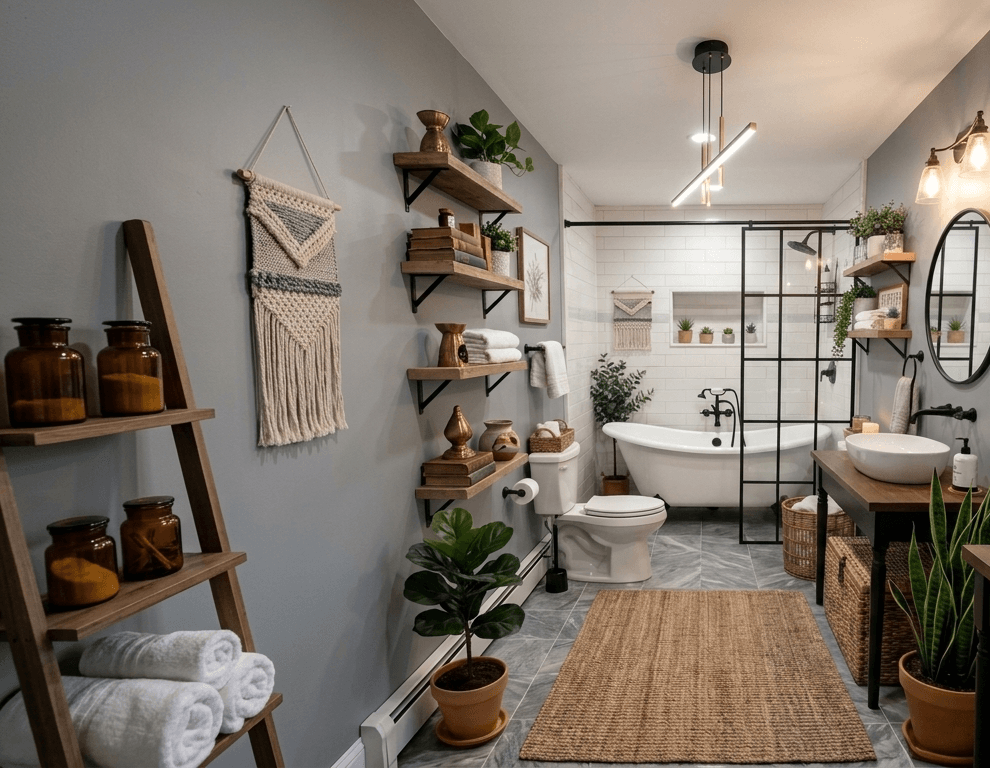
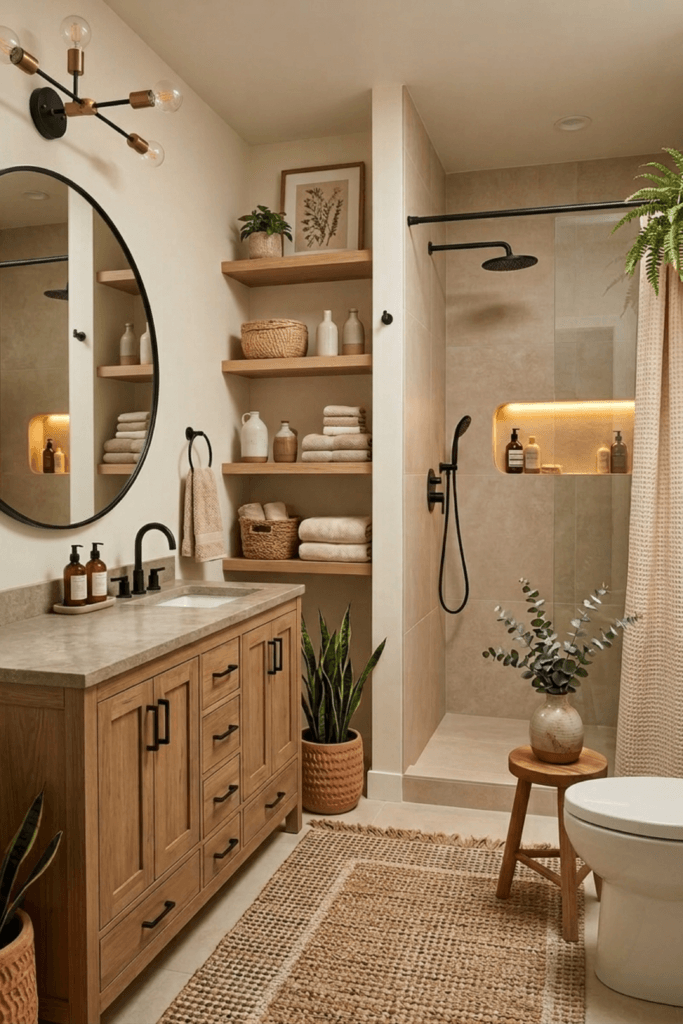
Why is it that a tiny hotel bathroom can feel calm and luxurious — while your own bathroom somehow feels stressful before the day even starts?
Usually, it’s not the size of the room.
It’s the visual friction inside it.
The crowded counter. The mismatched bottles. The shelves trying to hold too much at once.
The feeling that your eyes never get to rest.
Visual noise works like static in the background. Your brain keeps processing every little object, color shift, and unfinished corner without you even noticing it.
That’s why some bathrooms feel instantly calming the second you walk in — and others feel mentally loud.
A small bathroom doesn’t need more decoration.
It needs less friction.
Less visual weight.
More breathing room.
A system that works quietly in the background.
The room doesn’t feel bigger because of square footage.
It feels bigger because your eyes can finally move freely.
Why Small Bathrooms Feel Overwhelming So Fast
Small spaces become exhausting when every surface competes for attention.
Your brain constantly scans:
- ◌ different packaging
- ◌ busy countertops
- ◌ harsh lighting
- ◌ too many colors
- ◌ visual interruptions
And the smaller the room is, the stronger that effect becomes.
That’s why decluttering alone often doesn’t fully solve the problem.
You don’t just need less stuff.
You need more visual silence.
Sometimes the calmest part of a room is the part left intentionally empty.
Not every corner needs decoration.
Sometimes an empty corner feels more luxurious than a forced styling moment.
Negative space creates calm.
Use Vertical Space Instead of Letting Everything Live on the Counter
Problem:
Most small bathrooms lose visual space because storage spreads horizontally.
Everything ends up on the vanity: skincare, towels, brushes, extra products, baskets, candles.
The room starts feeling crowded instantly.
Shift:
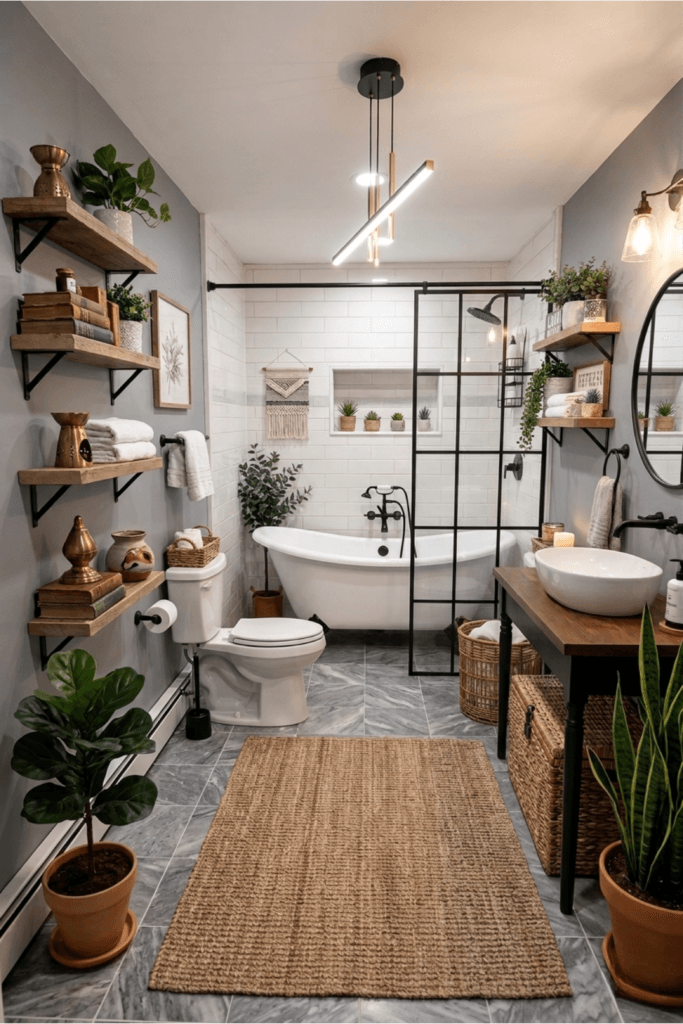
Move storage upward instead of outward.
Why it works:
When counters stay visually clear, the room immediately feels lighter.
Floating shelves create function without adding heavy visual blocks. They also draw the eye upward, which subtly makes ceilings feel taller.
Think of shelves as the lungs of the wall.
If you overcrowd them, the room can’t breathe.
Quick application:
Use 2–3 simple wood shelves with matching baskets or folded neutral towels.
And leave breathing room between objects.
Not every shelf needs to be full.
How to Make a Bathroom Feel Bigger With Less Visual Noise
Problem:
Too many different product bottles create constant visual interruptions.
Look at the edge of your sink.
How many different colors do you see?
If it’s more than three, your brain is already working harder than it needs to.
Shift:
Reduce visible variation.
Why it works:
The brain reads grouped and matching objects as one visual unit instead of twenty separate distractions.
That lowers friction immediately.
Luxury hotels understand this extremely well.
They don’t necessarily have fewer products.
They simply make everything feel visually unified.
Quick application:
Transfer everyday products into matching amber or neutral dispensers.
If every bottle looks different, the eye experiences clutter even when the room is technically organized.
But when packaging becomes cohesive, the room instantly feels calmer.
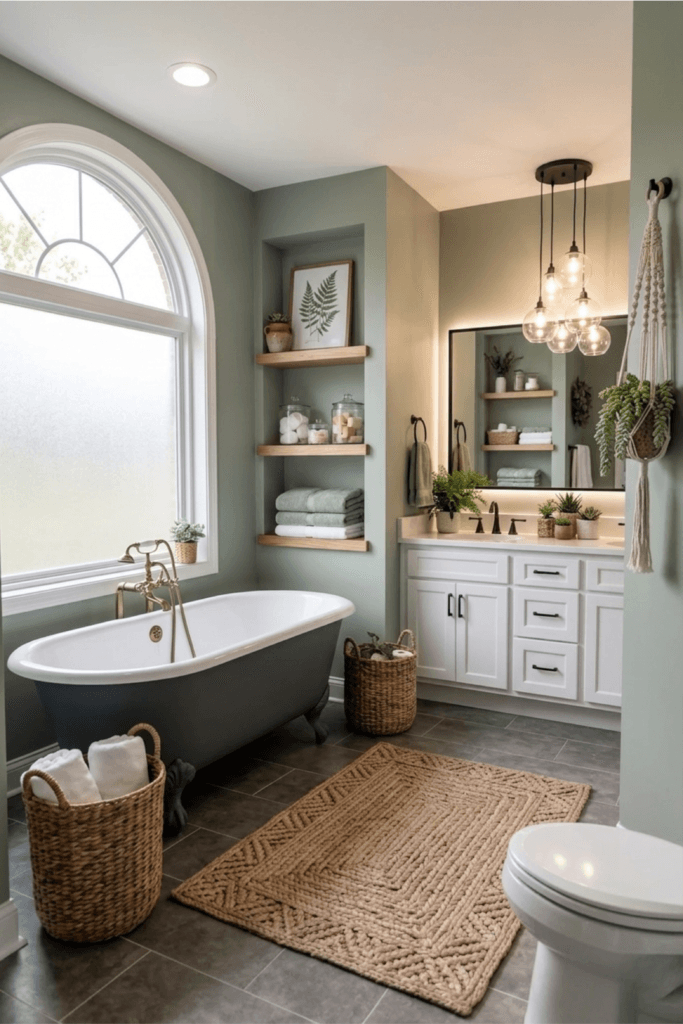
Bathrooms That Feel Bigger Usually Repeat the Same Materials
Problem:
Many bathrooms feel chaotic because too many finishes compete with each other.
Chrome.
Black metal.
Bright plastic.
Cool gray tile.
Warm wood.
Five towel colors.
Your eyes keep stopping and restarting.
Shift:
Choose fewer materials and repeat them intentionally.
Why it works:
Consistency creates softness.
When textures and tones repeat throughout the room, your eyes move more smoothly across the space.
That movement creates calm instead of chaos.
Quick application:
Pick 2–3 dominant finishes only.
- ◌ warm wood
- ◌ soft black hardware
- ◌ neutral textiles
Then repeat them consistently.
The goal is cohesion, not perfection.
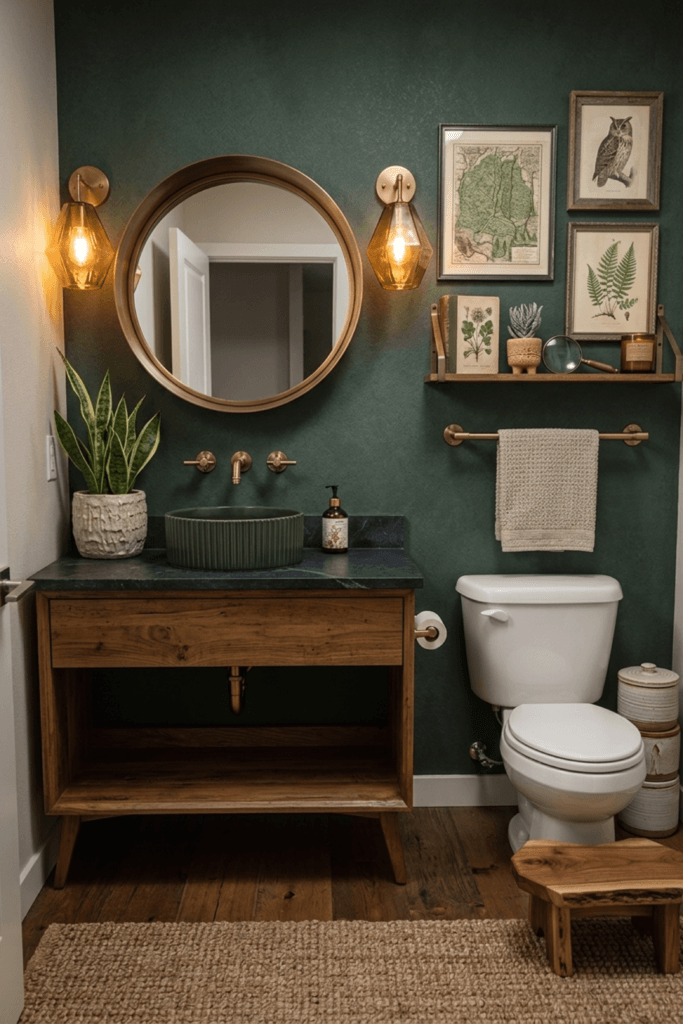
How to Use Lighting to Make a Small Bathroom Feel Softer
Problem:
Cold overhead lighting exaggerates clutter and removes depth from the room.
Everything feels flatter and harsher.
Shift:
Layer softer, warmer lighting.
Why it works:
Warm lighting softens edges and reduces visual tension.
Even a very small bathroom starts feeling more dimensional and relaxed.
This is one reason spa bathrooms feel calming.
The light doesn’t attack the room.
It softens it.
Quick application:
Switch cool white bulbs to warm light.
Add subtle mirror lighting or warm sconces if possible.
Even one softer secondary light source can completely change the atmosphere at night.
Small Bathroom Ideas That Create the Illusion of More Space
Problem:
Low visual lines make ceilings feel shorter and the room feel tighter.
Shift:
Use visual tricks that guide the eye upward and keep the floor visible.
Why it works:
The brain perceives openness through sightlines.
More visible floor space and taller visual proportions create the feeling of a larger room — even without changing the layout.
Quick application:
- ✓ Hang shower curtains closer to the ceiling
- ✓ Use mirrors that visually expand the wall
- ✓ Choose furniture with visible legs when possible
- ✓ Keep floor corners open instead of filling them with storage
Sometimes the room doesn’t need more space.
It just needs fewer visual stops.
The Clear Surface Rule
If you want your bathroom to feel instantly bigger, clear at least one surface completely.
Usually:
- ◌ the vanity counter
- ◌ the shower ledge
- ◌ the floor corners
Empty space creates visual silence.
And visual silence is what allows the room to breathe.
30-Minute Small Bathroom Reset
- ✓ Clear every surface completely
- ✓ Put back only your daily essentials
- ✓ Use one towel color only
- ✓ Hide colorful packaging
- ✓ Raise the shower curtain closer to the ceiling
- ✓ Leave one shelf partially empty
- ✓ Switch to warm lighting
- ✓ Remove anything you don’t use weekly
The goal isn’t minimalism.
It’s less friction.
The Goal Isn’t a Perfect Bathroom
A calm bathroom doesn’t happen because everything is expensive or perfectly styled.
It happens when the room stops demanding constant attention from your brain.
When surfaces can breathe.
When storage feels intentional.
When textures feel cohesive.
When visual noise disappears quietly into the background.
That’s when even a small bathroom starts feeling softer.
Not bigger because the walls changed.
Bigger because the experience changed.
The luxury of a room isn’t defined by its square footage, but by the quietness of its details.