
If you work from home and constantly feel busy but not productive, this simple 2-block method might be the work from home routine that finally changes everything.
I used to end my days exhausted, slightly anxious, and still somehow behind. My to-do list was full. My calendar looked structured. I was “doing things” all day. But the one thing that actually mattered? That rarely moved forward.
Working from home can quietly turn into constant shallow activity. Emails. Messages. Small edits. Notifications. Tiny admin tasks that feel productive but do not create real progress.
The 2-Block Method is the simplest structure I have found that actually works. It is minimal. It is realistic. And it is designed for deep focus, not constant hustle.
What Is the 2-Block Method?
The 2-Block Method is a simple work from home productivity routine built around two intentional work blocks per day:
- Block 1: Deep Work
- Block 2: Structured Shallow Work
Instead of scattering your attention across 8 to 10 mini tasks all day, you decide in advance:
What is the one outcome that truly matters today?
Then you protect time for it.
No complicated productivity systems. No color-coded chaos. Just clarity and protected focus.
Step 1: Choose Your One Daily Outcome
This is where most people fail.
They plan tasks instead of outcomes.
There is a big difference between:
- “Work on website”
- “Write 1200 words of blog post draft”
The first is vague. The second is measurable.
When using the 2-Block Method, you choose one meaningful result for the day. Not ten. Not five. One.
Ask yourself:
- If I could only finish one thing today, what would actually move my business or career forward?
- What creates progress, not just motion?
This becomes your Deep Work outcome.
Clarity reduces anxiety. And anxiety is what usually destroys focus.
Deep Work vs Shallow Tasks
Deep Work
Deep work is cognitively demanding, distraction-free work that creates long-term value.
It requires thinking. Creating. Solving. Building.
Examples include writing, designing, strategic planning, product development, or learning complex skills.
Shallow Tasks
Shallow work is logistical, reactive, and usually easy.
Answering emails. Scheduling posts. Updating spreadsheets. Responding to messages.
The problem is not shallow work. The problem is when shallow work takes over your entire day.
The 2-Block Method prevents that.
How Time Boxing Makes This Routine Work
The 2-Block Method relies on time boxing.
Time boxing means you assign a fixed time window to a specific type of work. You are not working “until done.” You are working inside a clearly defined boundary.
This reduces procrastination and perfectionism.
Here is a simple structure:
- 9:00–12:00 Deep Work Block
- 14:00–15:00 Admin and shallow tasks
- 16:30 Shutdown ritual
During 9:00–12:00, you focus only on your one defined outcome. No email. No notifications. No multitasking.
During 14:00–15:00, you batch emails, messages, and admin tasks.
At 16:30, you close loops, plan tomorrow’s outcome, and shut down.
This structure is simple, but powerful.
A Sample Work From Home Day Using the 2-Block Method
8:45 Review your one outcome for the day
9:00–12:00 Deep Work Block
12:00–14:00 Lunch and reset
14:00–15:00 Admin and shallow tasks
15:00–16:30 Light tasks or creative exploration
16:30 Shutdown ritual
Notice what is missing.
No constant checking. No reactive mode all day. No random task switching every 20 minutes.
You protect your most valuable cognitive energy first.
Why This Method Actually Works for Remote Workers
Working from home removes external structure. That freedom can quickly turn into distraction.
The 2-Block Method replaces missing structure with intentional structure.
It works because it reduces decision fatigue, forces clarity on what matters, prevents shallow work from dominating, and creates a defined end to your workday.
Why I Created a Printable Around This Structure
After testing this routine for months, I realized something important.
Most planners are beautiful. But they do not enforce clarity.
They give you space to write endless tasks. They do not force you to choose one meaningful outcome. They do not visually separate deep work from shallow admin.
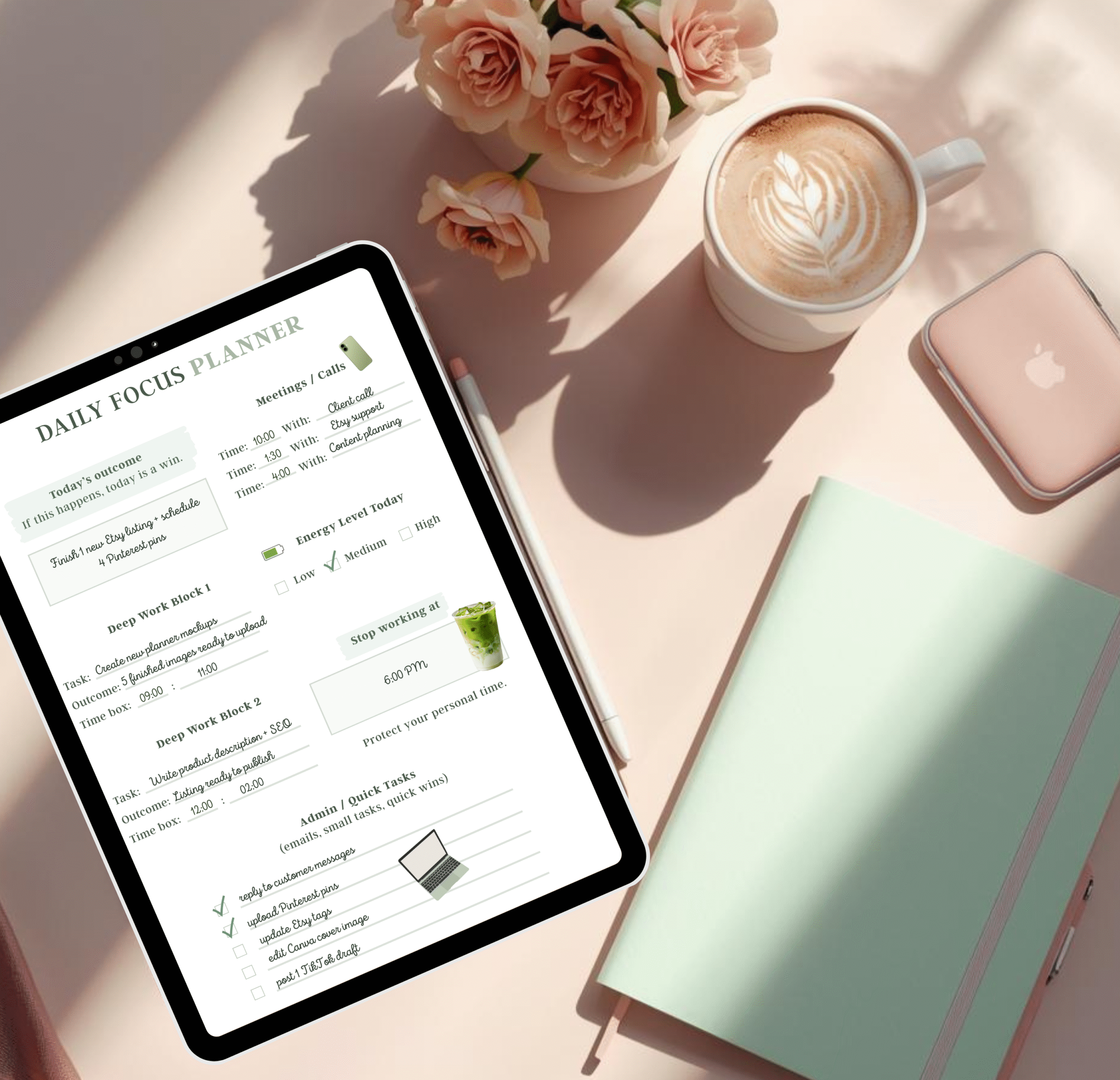
So I created a simple Time Blocking Focus System Printable based exactly on this method.
Not because the world needed another planner. But because I needed a page that visually forced me to commit to one outcome, protect a deep work block, and separate reactive tasks from real progress.
The layout mirrors the 2-block structure. Clear outcome section. Dedicated deep work space. Structured shallow task area. And a small shutdown reflection to close the day intentionally.
If you are building something from home, whether that is a business, creative work, or focused career development, structure matters more than motivation.
This is simply a tool that supports that structure.
The Shutdown Ritual That Protects Your Evenings
The final piece of the 2-Block Method is the shutdown ritual.
At 16:30 or whatever time you choose, you review what was completed, define tomorrow’s one outcome, close open tabs, and write down loose thoughts.
This signals to your brain that work is done.
Without a shutdown ritual, remote work quietly bleeds into the evening. You check email at 21:00. You think about unfinished tasks in bed.
A clear ending creates psychological safety.
If You Feel Busy But Not Productive
You probably do not need a more complicated system.
You need one meaningful outcome. One protected deep work block. One structured shallow block. And a defined shutdown.
The 2-Block Method is not trendy productivity content.
It is simple structure that protects your focus.
And sometimes that is exactly what finally works.