The 2-Block Method: The Simplest Work From Home Routine That Actually Works

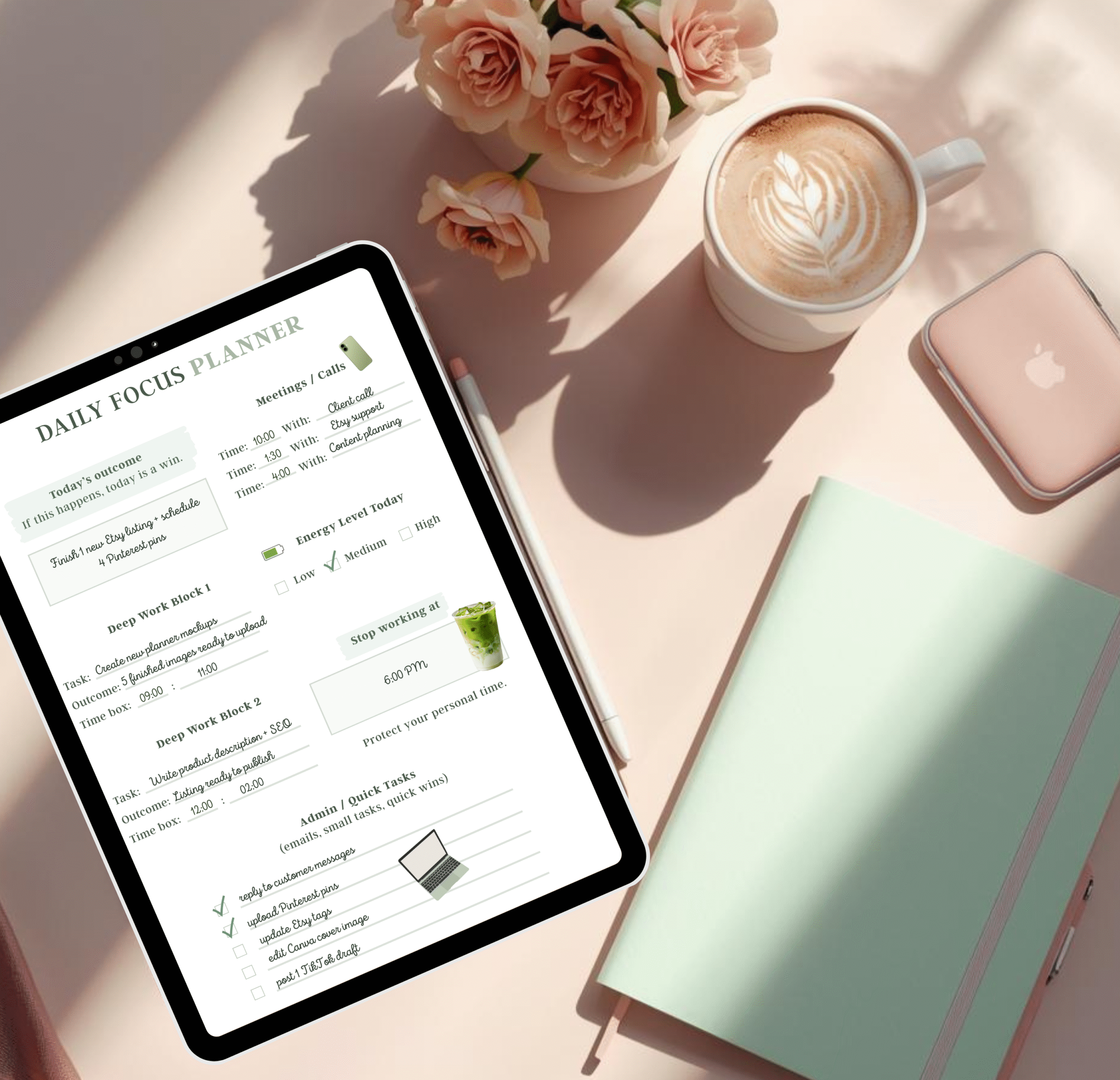
Daily focus planner displayed on a tablet showing a time blocking layout with deep work blocks, admin tasks, and shutdown time, styled in soft neutral tones on a desk with coffee, flowers, and a sage green notebook.

If you work from home and constantly feel busy but not productive, this simple 2-block method might be the work from home routine that finally changes everything.

I used to end my days exhausted, slightly anxious, and still somehow behind. My to-do list was full. My calendar looked structured. I was “doing things” all day. But the one thing that actually mattered? That rarely moved forward.

Working from home can quietly turn into constant shallow activity. Emails. Messages. Small edits. Notifications. Tiny admin tasks that feel productive but do not create real progress.

The 2-Block Method is the simplest structure I have found that actually works. It is minimal. It is realistic. And it is designed for deep focus, not constant hustle.

What Is the 2-Block Method?

The 2-Block Method is a simple work from home productivity routine built around two intentional work blocks per day:

  • Block 1: Deep Work
  • Block 2: Structured Shallow Work

Instead of scattering your attention across 8 to 10 mini tasks all day, you decide in advance:

What is the one outcome that truly matters today?

Then you protect time for it.

No complicated productivity systems. No color-coded chaos. Just clarity and protected focus.

Step 1: Choose Your One Daily Outcome

This is where most people fail.

They plan tasks instead of outcomes.

There is a big difference between:

  • “Work on website”
  • “Write 1200 words of blog post draft”

The first is vague. The second is measurable.

When using the 2-Block Method, you choose one meaningful result for the day. Not ten. Not five. One.

Ask yourself:

  • If I could only finish one thing today, what would actually move my business or career forward?
  • What creates progress, not just motion?

This becomes your Deep Work outcome.

Clarity reduces anxiety. And anxiety is what usually destroys focus.

Deep Work vs Shallow Tasks

Deep Work

Deep work is cognitively demanding, distraction-free work that creates long-term value.

It requires thinking. Creating. Solving. Building.

Examples include writing, designing, strategic planning, product development, or learning complex skills.

Shallow Tasks

Shallow work is logistical, reactive, and usually easy.

Answering emails. Scheduling posts. Updating spreadsheets. Responding to messages.

The problem is not shallow work. The problem is when shallow work takes over your entire day.

The 2-Block Method prevents that.

How Time Boxing Makes This Routine Work

The 2-Block Method relies on time boxing.

Time boxing means you assign a fixed time window to a specific type of work. You are not working “until done.” You are working inside a clearly defined boundary.

This reduces procrastination and perfectionism.

Here is a simple structure:

  • 9:00–12:00 Deep Work Block
  • 14:00–15:00 Admin and shallow tasks
  • 16:30 Shutdown ritual

During 9:00–12:00, you focus only on your one defined outcome. No email. No notifications. No multitasking.

During 14:00–15:00, you batch emails, messages, and admin tasks.

At 16:30, you close loops, plan tomorrow’s outcome, and shut down.

This structure is simple, but powerful.

A Sample Work From Home Day Using the 2-Block Method

8:45 Review your one outcome for the day

9:00–12:00 Deep Work Block

12:00–14:00 Lunch and reset

14:00–15:00 Admin and shallow tasks

15:00–16:30 Light tasks or creative exploration

16:30 Shutdown ritual

Notice what is missing.

No constant checking. No reactive mode all day. No random task switching every 20 minutes.

You protect your most valuable cognitive energy first.

Why This Method Actually Works for Remote Workers

Working from home removes external structure. That freedom can quickly turn into distraction.

The 2-Block Method replaces missing structure with intentional structure.

It works because it reduces decision fatigue, forces clarity on what matters, prevents shallow work from dominating, and creates a defined end to your workday.

Why I Created a Printable Around This Structure

After testing this routine for months, I realized something important.

Most planners are beautiful. But they do not enforce clarity.

They give you space to write endless tasks. They do not force you to choose one meaningful outcome. They do not visually separate deep work from shallow admin.

So I created a simple Time Blocking Focus System Printable based exactly on this method.

Not because the world needed another planner. But because I needed a page that visually forced me to commit to one outcome, protect a deep work block, and separate reactive tasks from real progress.

The layout mirrors the 2-block structure. Clear outcome section. Dedicated deep work space. Structured shallow task area. And a small shutdown reflection to close the day intentionally.

If you are building something from home, whether that is a business, creative work, or focused career development, structure matters more than motivation.

This is simply a tool that supports that structure.

The Shutdown Ritual That Protects Your Evenings

The final piece of the 2-Block Method is the shutdown ritual.

At 16:30 or whatever time you choose, you review what was completed, define tomorrow’s one outcome, close open tabs, and write down loose thoughts.

This signals to your brain that work is done.

Without a shutdown ritual, remote work quietly bleeds into the evening. You check email at 21:00. You think about unfinished tasks in bed.

A clear ending creates psychological safety.

If You Feel Busy But Not Productive

You probably do not need a more complicated system.

You need one meaningful outcome. One protected deep work block. One structured shallow block. And a defined shutdown.

The 2-Block Method is not trendy productivity content.

It is simple structure that protects your focus.

And sometimes that is exactly what finally works.

Leave a Comment

How to Stay Focused Working From Home (Without Burning Out or Working All Day)

Woman working from home on a laptop while sitting on a sofa in a bright living room with city view, calm remote work lifestyle

Working from home sounds like a dream. No commute. No office noise. No awkward small talk. Just you, your laptop, and your own schedule.

But then real life happens.

The laundry is staring at you. Your phone keeps lighting up. You open your laptop “just to check one email” and suddenly it’s 7 PM and you feel like you worked all day… yet nothing important is actually done.

If that sounds familiar, you are not lazy. You are not undisciplined. And you are definitely not alone.

Working from home is mentally exhausting because your brain has no clear boundaries. The day never feels finished. And when you don’t know what “done” looks like, you keep working forever.

This article will show you how to stay focused working from home using a simple daily system that helps you get real work done, protect your energy, and actually log off without guilt.


Why It’s So Hard to Stay Focused Working From Home

When people talk about productivity, they often act like the solution is “discipline.”

But the truth is, home office focus problems are usually caused by structure problems.

In an office, your environment creates natural pressure:

  • You start at a certain time.
  • You have meetings that break up the day.
  • You see other people working.
  • You leave the building, and your brain understands: work is over.

At home, those signals disappear. And your brain stays in a constant half-working mode.

This is why so many remote workers feel like they are always behind, even when they are technically “working all day.”

You are constantly switching between:

  • work tasks
  • small admin tasks
  • messages
  • household distractions
  • unfinished thoughts

That constant switching drains your mental energy. And the result is burnout, frustration, and the feeling that you are never doing enough.


The Real Problem: You’re Trying to Do Too Much at Once

Most people start their day with a long to-do list.

And it looks productive at first.

But the longer the list, the more your brain goes into survival mode.

You jump between tasks. You procrastinate. You start things but never finish them. You feel busy but not effective.

And at the end of the day, the important work is still waiting.

That is why the key to focus is not doing more.

The key to focus is choosing fewer things and finishing them.


A Simple System That Actually Works (Even If You’re Easily Distracted)

When I started working from home, I tried everything:

  • strict schedules
  • time blocking
  • fancy productivity apps
  • writing endless lists

And honestly, most of it just made me feel worse. Because it felt like I needed to become a different person to stay focused.

What finally worked was something much simpler.

A system based on one rule:

Plan less. Execute more.

Instead of planning 20 tasks, I started planning my day around a few outcomes.

And the difference was huge.


Step 1: Decide What Would Make Today a Win

If you want to stay focused working from home, you need one clear target.

Not a list of random tasks.

A real outcome.

Ask yourself:

“If this one thing is done, today was a success.”

That could be:

  • finishing a client project
  • writing a report
  • editing content
  • sending an important email
  • planning your next week

When you define your win, your brain finally knows what it is working toward.

This is the difference between feeling scattered and feeling grounded.


Step 2: Plan Only 2 Deep Work Blocks (No More)

This part is the hardest for people, because it feels “too little.”

But it works because your brain has limited deep focus energy.

Deep work is the work that moves your life forward:

  • writing
  • designing
  • building a business
  • creating content
  • strategy
  • important problem-solving

It is not checking emails. It is not organizing files. It is not scrolling “for inspiration.”

Those things are shallow tasks, and they can be done later.

Choose two deep work blocks for your day:

  • Deep Work Block 1: your most important task
  • Deep Work Block 2: your second most important task

That’s it.

Because when you plan too much, you don’t finish anything. When you plan less, you execute more.


Step 3: Time-Box Everything (So Work Doesn’t Expand Forever)

One of the biggest reasons working from home feels endless is simple:

Work expands when you don’t give it an end.

So instead of saying “I’ll work on this project today,” you decide:

“I will work on this for 90 minutes.”

Time-boxing is powerful because it creates urgency without stress.

You stop overthinking. You stop perfectionism. You start moving.

Some simple time-box examples:

  • 90 minutes for writing
  • 60 minutes for editing
  • 30 minutes for emails
  • 45 minutes for admin tasks

When time is up, you either stop or reschedule. That is how you protect your energy.


Step 4: Separate Shallow Tasks From Deep Work

Most people destroy their focus by mixing shallow tasks into deep work time.

You sit down to work, but then you check one email.

Then you reply to another.

Then you open social media “for 2 minutes.”

Then you remember a small task and do it quickly.

And suddenly your brain is exhausted.

This is why a simple separation makes a massive difference:

  • Deep Work: creative, strategic, high-focus tasks
  • Shallow Tasks: emails, admin, small wins, organizing

Both matter. But they should not happen at the same time.


Step 5: Create a Shutdown Ritual (This Changes Everything)

This is the part most remote workers ignore, and it’s the reason burnout happens so fast.

If your brain never receives a clear “end” signal, it stays in work mode all evening.

You might stop working physically, but mentally you are still there.

A shutdown ritual is a simple closing routine that tells your brain:

“We are done for today.”

Your shutdown ritual can take 5 minutes. It does not need to be complicated.

Here’s a simple version:

  • wrap up loose ends
  • write down tomorrow’s first task
  • close your laptop
  • clean your workspace (optional)

That last step is important. Physically closing the laptop is a psychological reset.

It creates boundaries even when your office is your kitchen table.


A Realistic Work From Home Daily Routine Example

If you want a simple structure, here is a realistic schedule that works for many remote workers:

  • 09:00–09:15 Plan your day (choose your “win”)
  • 09:15–11:00 Deep Work Block 1
  • 11:00–11:30 Break + movement
  • 11:30–12:30 Meetings or shallow tasks
  • 13:30–15:00 Deep Work Block 2
  • 15:00–16:00 Admin tasks + emails
  • 16:00–16:15 Shutdown ritual

And then you stop.

Not because everything is finished, but because your workday is finished.

This is how you protect your personal time and prevent burnout.


The Secret to Staying Focused Working From Home Is Consistency

Most people search for the perfect productivity hack.

But focus comes from repetition.

When you use the same simple system every day, your brain starts trusting it.

You stop overthinking. You stop reinventing your schedule every morning.

You just sit down and execute.

Consistency beats intensity.

Even if you only have 3 focused hours, those hours will outperform 10 scattered hours every single time.


If You Want a Printable System to Make This Easy

If you love the idea of this method but you want something that makes it effortless to follow, I created a simple printable system designed specifically for remote work focus.

It includes:

  • a Daily Focus Planner page
  • space for deep work blocks
  • shallow/admin task planning
  • work-life split section
  • a shutdown ritual checklist
  • a weekly focus overview to stay consistent

You can check it out here:

Work From Home Focus System Printable (Etsy Listing)

It’s minimal, calm, and designed for people who want to get things done without living in hustle mode.


Final Thoughts

Working from home does not have to feel chaotic.

You don’t need a complicated planner. You don’t need 15 apps. You don’t need to wake up at 5 AM.

You just need a clear outcome, two deep work blocks, a time limit, and a shutdown ritual.

Because the goal is not to work more.

The goal is to finish your work without working all day.

If this article helped you, feel free to save it, share it, or come back to it whenever your days start feeling scattered again.

Leave a Comment

Woman holding an iced coffee in a cozy neutral home office setup with laptop, headphones and candle, representing calm productivity and focus planning.

How to Plan Your Day With ADHD When Everything Feels Urgent

Some days don’t feel busy. They feel like a full emergency.

You wake up already behind. Your brain starts listing problems before you even get out of bed. Messages you forgot to answer. Work you didn’t finish. A million tiny tasks that suddenly feel like they will ruin your entire life if you ignore them.

If you have ADHD (or you are simply mentally overloaded), you know the exact feeling: everything feels urgent, but your brain can’t decide what to do first.

So you freeze.

Or you start doing random small tasks to feel productive. Or you open your laptop and somehow end up scrolling, switching tabs, answering low-priority emails, and by the end of the day you feel exhausted with nothing meaningful finished.

And the worst part is this: you were trying.

You weren’t lazy. You weren’t careless. You weren’t “unmotivated.” Your brain was overloaded with too many priorities competing for attention.

This is exactly why classic planning advice fails for ADHD brains.

Because when everything feels urgent, you don’t need a longer to-do list.

You need a system that forces clarity.


Why ADHD Makes Everything Feel Urgent

When you have ADHD, your brain doesn’t automatically rank tasks the way other people’s brains do.

To your mind, these things can feel equally loud:

  • Answering one email
  • Starting a project
  • Cleaning the kitchen
  • Paying a bill
  • Organizing your entire life

They all create the same emotional pressure: “Do this now or you’ll forget.”

So your day becomes a panic-driven reaction loop.

You do what feels most stressful in the moment, not what actually matters most long-term.

This is why ADHD planning is not about motivation.

It’s about reducing the number of decisions your brain has to make.


The Biggest Mistake: Trying to Plan Like a “Normal” Brain

Most productivity systems assume your brain works like this:

  • Write down tasks
  • Pick the most important one
  • Do it
  • Move to the next

But ADHD brains often work like this:

  • Write down tasks
  • Feel overwhelmed by the list
  • Start the easiest task for dopamine
  • Get interrupted
  • Forget the original task
  • Start something else
  • Lose track of time
  • Feel guilty and shut down

So if you keep using planners built for neurotypical routines, you will always feel like you are failing.

You are not failing.

The system is failing you.


The ADHD-Friendly Rule: Choose One Anchor Task

This is the rule that changed everything for me:

If only one thing gets done today, it’s this.

I call it Today’s One Win.

It is not a vague goal like “be productive” or “catch up.”

It is one concrete task that would make the day feel successful.

For example:

  • Finish and send the client email draft
  • Write 500 words of the blog post
  • Clean the kitchen counters (not the whole house)
  • Submit the application form
  • Schedule the doctor appointment

When you pick one anchor task, something powerful happens:

The day stops being a battlefield.

Because now you have a target. Your brain has a direction.


How to Pick Your One Win (When Everything Feels Important)

If you struggle to choose, here is a simple way to decide:

Ask yourself:

  • Which task will reduce stress the most tomorrow?
  • Which task moves money, deadlines, or real progress forward?
  • Which task will make me feel relief if it’s done?

That is your One Win.

Not the most urgent-feeling task. The most meaningful one.

ADHD urgency is emotional. Your plan needs to be logical.


The Simple ADHD Daily Structure That Actually Works

Once you have your One Win, you build the rest of your day around it.

Not around twenty other tasks.

Just around one clear priority.

Here is the exact structure that works best when your brain feels scattered:

1. Quick Check-In (Energy + Mood)

This takes 10 seconds, but it changes your whole plan.

Write:

  • Energy: low / medium / high
  • Mood: anxious / distracted / calm / tired / overwhelmed

Why does this matter?

Because ADHD planning fails when you build a schedule that doesn’t match your energy.

A low-energy day needs a low-energy plan.

That is not weakness. That is realism.


2. Write Your One Win at the Top

Make it big. Make it visible. Make it impossible to ignore.

Today’s One Win: ____________________

This becomes your anchor.

If you do nothing else, the day still counts.


3. Add Only Three Supporting Tasks

Not ten. Not fifteen.

Just three.

These are tasks that support your One Win, not distract from it.

Examples:

  • Answer urgent messages (15 minutes)
  • Prep tomorrow’s meeting notes
  • Pay one bill

The rule is simple:

If it doesn’t support your main focus, it does not go on today’s list.


4. Use Soft Time Blocks (Not Hour-by-Hour Scheduling)

Most ADHD brains hate strict schedules because they break the moment you get interrupted.

Instead, use soft blocks:

  • Morning Focus Block (your hardest task)
  • Midday Focus Block (continuation or admin)
  • Evening Light Block (easy tasks only)

This works because it creates structure without trapping you.

You still have freedom, but your attention has boundaries.


5. Add a Distraction Dump

This is one of the most underrated ADHD tools.

Because distractions are not random.

They are unfinished thoughts.

Your brain interrupts you with:

  • “I should check my bank app.”
  • “Maybe I should rewrite the Etsy listing title.”
  • “I need to clean the bathroom.”
  • “What if my whole strategy is wrong?”

If you fight those thoughts, they get louder.

If you write them down, your brain relaxes because it trusts you won’t forget.

So instead of tab-hopping, you dump the thought onto paper and return to your One Win.

Distraction Dump:

  • ____________________
  • ____________________
  • ____________________

6. Track Basic Needs (Because ADHD Focus Runs on Body Basics)

This sounds simple, but it’s the difference between a functional day and a crash.

On chaotic days, most “productivity problems” are actually:

  • dehydration
  • skipped meals
  • no movement
  • overstimulation

So your daily page should include a small tracker for:

  • water
  • meals
  • movement
  • medication (if relevant)

Because you cannot think clearly if your body is running on fumes.


A Real Example: A Chaotic ADHD Workday Plan

Let’s say your day is already messy.

Your inbox is full. Your brain is loud. You feel behind.

This is how the page might look:

Energy: Low
Mood: Anxious + distracted

Today’s One Win: Finish and publish the blog post draft.

Supporting tasks:

  • Reply to urgent emails (15 minutes max)
  • Create 2 Pinterest pins for the planner
  • Send invoice

Morning Focus Block: Draft the blog post (45 minutes)
Midday Focus Block: Format headings + finalize
Evening Light Block: Pinterest pins + admin

Distraction Dump:

  • Rename the Etsy file
  • Clean the kitchen
  • Research new niches

Notice what happens here.

You are not trying to “fix your life.”

You are simply building a plan that makes one real win possible.

That is what ADHD planning should be.


The ADHD Secret: Planning Once, Then Doing

This is the part most people miss.

The goal of a daily planning page is not to make you plan all day.

It is to separate planning from doing.

You decide the structure once, in the morning.

Then you stop negotiating with your brain every five minutes.

Because decision fatigue is what destroys ADHD focus.

Every time you ask:

  • “What should I do next?”
  • “Should I answer this now?”
  • “Is this important?”

Your attention gets drained.

So the best ADHD planner is one that makes decisions for you ahead of time.


How to End the Day Without Feeling Like You Failed

ADHD brains have a cruel habit.

They forget everything they completed and only remember what they didn’t finish.

That is why you can work all day and still feel like you did nothing.

This is why your daily page should end with a simple section:

What I actually finished today:

  • ____________________
  • ____________________
  • ____________________

Even if the list is small, it creates proof.

And proof is what builds consistency.


Why This Works When Everything Feels Urgent

This structure works because it does not rely on motivation.

It works because it reduces overwhelm in practical ways:

  • It forces one priority so you stop spinning.
  • It limits tasks so your list stays realistic.
  • It uses flexible time blocks so interruptions don’t destroy your plan.
  • It gives distractions a place to go, so they stop hijacking you.
  • It tracks basics like water and meals, so focus doesn’t collapse.
  • It ends the day with proof, so guilt doesn’t erase progress.

It is not a “perfect day” system.

It is a survival structure for real-life days.


If You Want the Ready-to-Print Daily Page

You can absolutely sketch this structure on paper.

The important part is the framework: one win, three supports, time blocks, distraction dump, and done list.

But if you want a clean version you can print instantly (plus matching weekly and monthly pages), this is the ADHD-friendly planner I use:

View the ADHD Focus Planner on Etsy

It is designed for people who want structure without pressure.

Not a complicated productivity system.

Just a page that helps your brain stop scattering.


Final Thought

If your brain feels chaotic, the solution is not more tasks.

The solution is fewer decisions.

One clear win. One calm page. One direction for your attention.

Because when everything feels urgent, clarity is not a luxury.

It is the only way your day becomes manageable.

Leave a Comment

This Is What a Real, Chaotic Tuesday Looks Like on This Daily Planner

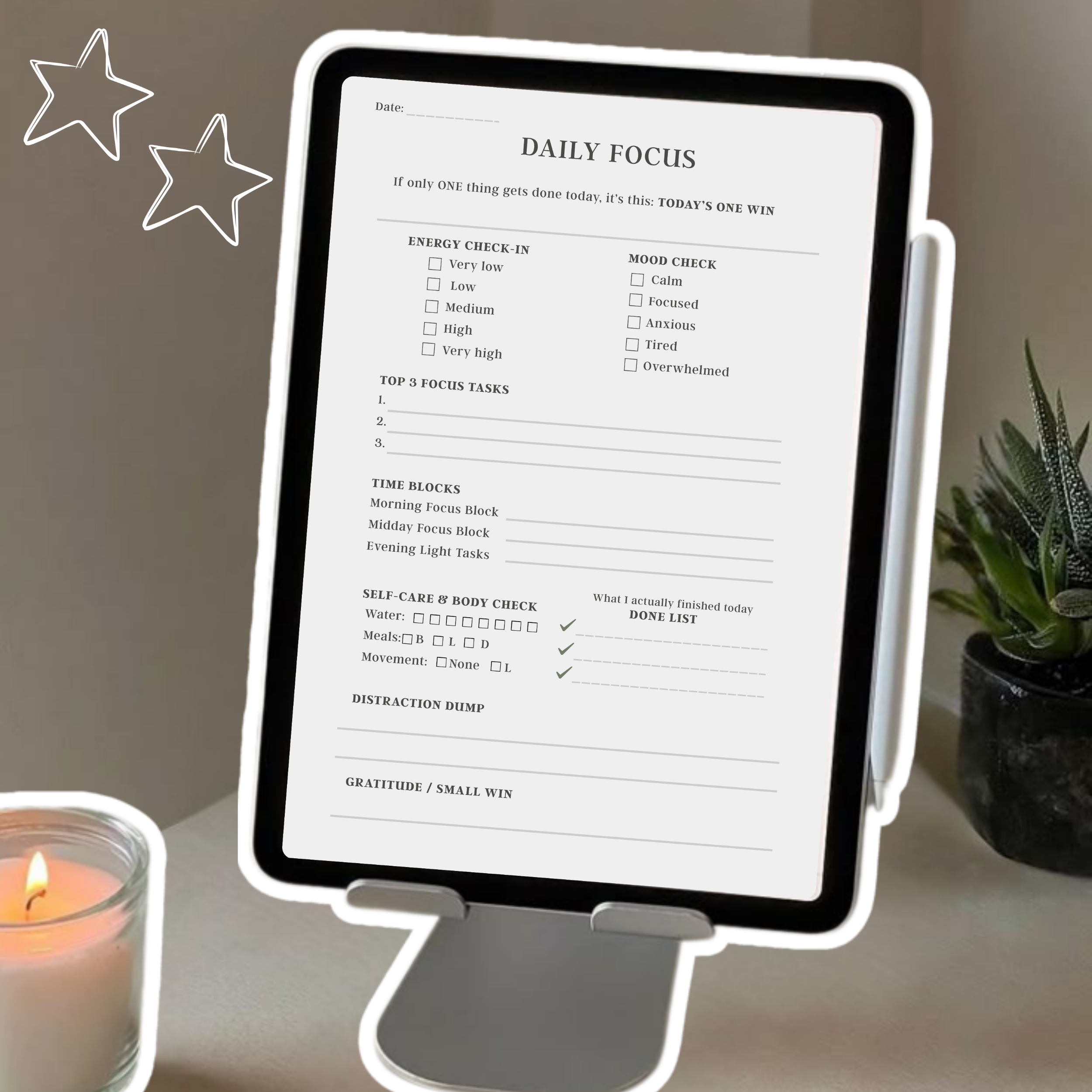
Minimal daily focus planner shown on a tablet, designed for ADHD-friendly planning with sections for energy check-in, mood check, top three focus tasks, time blocks, self-care tracking, distraction dump, and a done list.

Most “productive day” content online is fiction.

It is the clean desk, the color-coded schedule, the perfect breakfast, the 6AM workout, the calm inbox, the quiet mind. It assumes you wake up as a fully functioning CEO version of yourself, then glide from task to task with zero emotional turbulence and no unexpected interruptions.

That is not my Tuesday.

My Tuesday is the day that tries to swallow the week. It is the day where everything wants attention at the same time. It is the day where I have enough energy to start things, but not enough clarity to finish them cleanly. If you have an ADHD brain (or just an overloaded life), you know exactly what I mean.

So here is what I am going to do instead of pretending. I am going to show you how a real, messy, crowded Tuesday looks inside my daily planner page. Not an aesthetic fantasy. Not a perfect routine. A practical page that helps me salvage the day.

The Rule That Saves My Tuesday

Before we even touch the tasks, the page forces one decision:

If only ONE thing gets done today, it’s this: TODAY’S ONE WIN.

This is not motivational fluff. This is survival.

On a chaotic day, your brain will offer you twenty “urgent” things. Some are actually important. Most are noise. If you do not pick one anchor, you will bounce between micro-tasks, lose hours, then end the day feeling like you did nothing.

So on this Tuesday, my ONE WIN is:

Finish and publish the blog post draft (the real draft, not “work on it”).

That is it. Not “catch up on everything.” Not “be a new person.” Just one concrete win that moves your work forward.

Everything else becomes optional. Helpful, yes. Required, no.

Energy Check-In: I Stop Lying to Myself First

My Tuesday starts with an honesty check.

Energy Check-In: Low.

Not “Very low.” I can still think. But it is not a high-output day. If I pretend it is, I will overload myself by noon.

This matters because your plan has to match your energy. A low-energy plan is not “lazy.” It is accurate. It is the only way you stop building a day you cannot actually execute.

Mood Check: Name It So It Stops Running the Show

Mood Check: Anxious + Tired.

Not dramatic anxiety. The functional kind. The “I have too many open loops” kind. The “I forgot something, I can feel it” kind.

On Tuesdays, this mood usually comes from two sources:

  • Too many half-finished tasks from Monday.
  • Too many new demands arriving today.

The point is not to fix the mood in this box. The point is to acknowledge it, so it does not hijack every decision.

Top 3 Focus Tasks: The Anti-List List

This is where most people mess up. They write a list of 10 to 25 tasks, then call it planning. That is not planning. That is panic in bullet form.

On a chaotic Tuesday, I choose only three focus tasks. If I finish these, the day counts as a win even if everything else is imperfect.

Here is my real Top 3 today:

  1. Write and format the blog post draft (ONE WIN).
  2. Create 2 Pinterest pins for the planner listing.
  3. Answer only the high-impact messages (15 minutes max).

Notice what is not here:

  • Cleaning the whole apartment.
  • Fixing every Etsy listing.
  • Researching new niches for three hours.
  • Rebranding everything because you got bored.

Those things might be useful, but they are not the Tuesday priority. The planner page forces you to stop negotiating with distractions that dress up like work.

Time Blocks: I Plan Like Someone Who Gets Distracted

Time blocks work only when they are realistic and forgiving. On a low-energy Tuesday, I plan three blocks:

Morning Focus Block

45 minutes: Blog post draft, no tabs, no notifications.

Yes, 45 minutes. Not 3 hours. Not “all morning.” A real finish line.

Goal: get the ugly draft done. Not polished. Done.

Midday Focus Block

30 minutes: Format draft + add headings.

This is where you clean it up enough that future-you can publish it without pain.

Evening Light Tasks

20 minutes: Pinterest pins (2 designs) + save everything.

Evening is not for heavy thinking. It is for simple output. If you try deep work at night on a chaotic day, you will spiral into “I should redo everything.” Keep it light.

Self-Care & Body Check: Because Your Brain Runs on Basics

This section looks simple. It is not optional.

On chaotic days, “productivity problems” are often basic body problems. Hunger looks like procrastination. Dehydration looks like brain fog. No movement looks like restlessness.

So I track the boring stuff:

  • Water: steady sips. Not a dramatic goal, just consistency.
  • Meals (B L D): no “forget lunch” and then wonder why focus dies.
  • Movement: choose “L” (light). A short walk counts.

This is what keeps the day from collapsing. You do not need a perfect routine. You need enough stability that your brain stays online.

The Done List: Proof You Did Not Do “Nothing”

Here is the trap: on busy Tuesdays, you do a lot of small tasks, then forget all of them. Your brain only remembers what you did not do. That is how you end the day feeling like a failure even if you worked all day.

The Done List fixes that.

A real Done List on a chaotic Tuesday often looks like this:

  • Sent the important email you kept avoiding.
  • Fixed the file name issue on the download.
  • Wrote the intro + first half of the post.
  • Made lunch instead of skipping it.

Not glamorous. Real. And written proof stops the “I did nothing” lie.

Distraction Dump: Where You Park the Noise

This is the section that prevents mental chaos from turning into scrolling, tab-hopping, and fake work.

Distractions are not random. They are unfinished thoughts.

Your brain interrupts you with things like:

  • “You should change the Etsy title again.”
  • “What if you should restart your TikTok?”
  • “You forgot to reply to that comment.”
  • “You need a better thumbnail.”
  • “Maybe the whole strategy is wrong.”

If you fight these thoughts, they get louder. If you dump them on paper, they calm down because your brain trusts you will not forget.

The rule: if it is not related to TODAY’S ONE WIN, it goes in the Distraction Dump. Review later, when the day is not on fire.

Gratitude / Small Win: Not Soft, Just Necessary

Blunt truth: if you never record small wins, you will quit.

Not because you are weak. Because your brain will label every day as a loss if you do not mark progress.

On this Tuesday, the Small Win is:

I wrote even when my brain wanted to avoid it.

That is not aesthetic. That is consistency training.

What You Actually Finished Today: The Reality Check

This last line closes the loop:

What I actually finished today:

  • Drafted and formatted the blog post.
  • Created two Pinterest pins (saved as templates).
  • Replied only to the messages that affect money, delivery, or deadlines.

And yes, some things did not happen. Fine. They can live tomorrow. The day still counts.

Why This Planner Works on a Messy Life Day

This page works because it is built for real brains, not fantasy schedules.

  • It reduces decision overload by forcing one priority.
  • It limits the task list so you stop drowning in “shoulds.”
  • It uses realistic time blocks that match real energy.
  • It makes self-care measurable so focus does not crash.
  • It captures distractions without letting them steal the day.
  • It records proof so you stop thinking you did nothing.

Get the Same Daily Page

If you want to use this exact daily structure (plus the weekly and monthly pages), here is the planner link:

ADHD Focus Planner (Daily, Weekly & Monthly)

Use it for one week. Especially on your worst day. That is the real test.

Because if a planner only works when life is calm, it does not work.

Leave a Comment

How to Bring Order to a Chaotic Workday With One Simple ADHD Focus Page

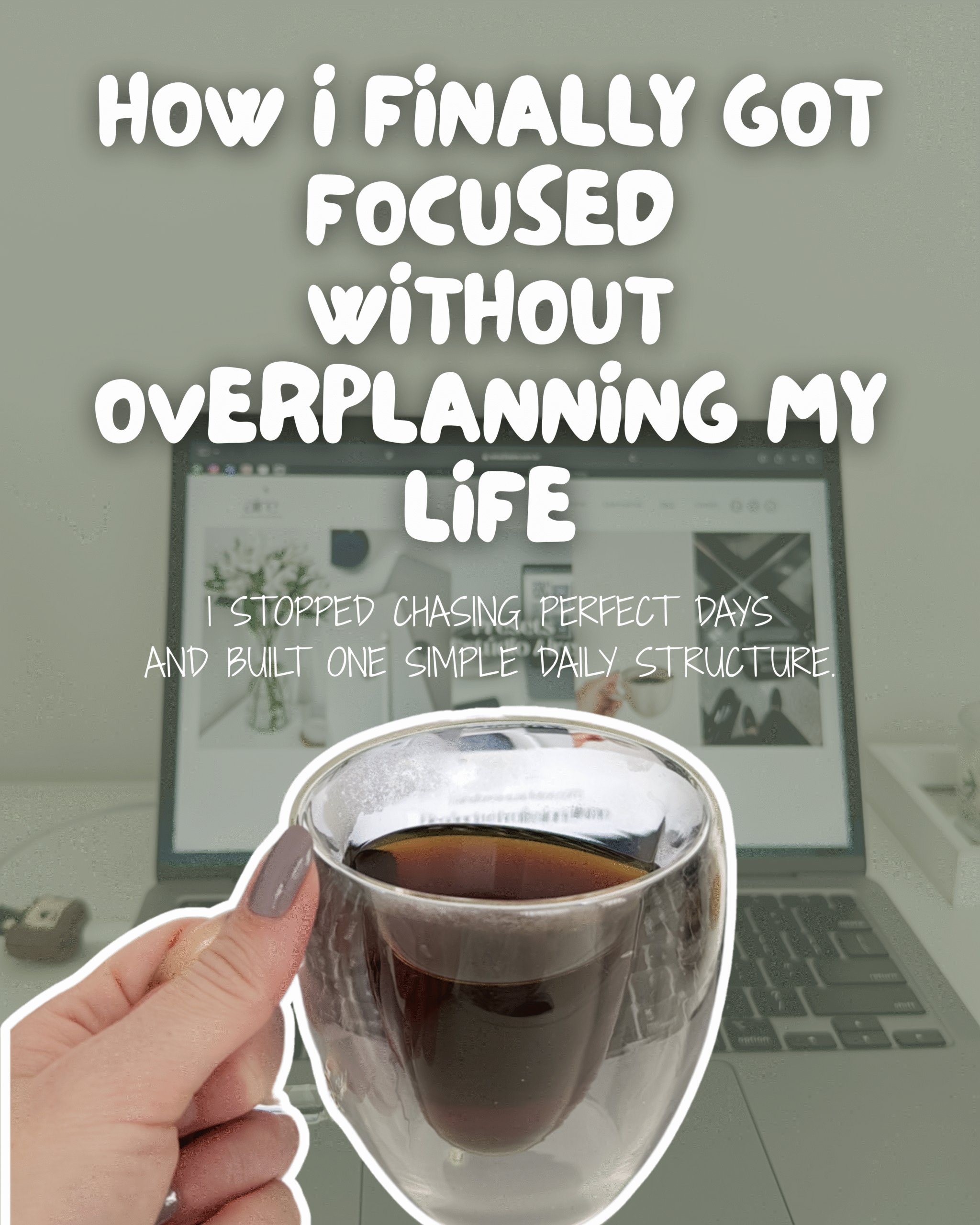
Woman holding a cup of coffee in front of a laptop with the text “How I finally got focused without overplanning my life”, representing a calm and simple daily focus routine for productive work.

Some days don’t fall apart all at once. They slowly leak away.

You open your laptop, check one email, then another. You start a task, get interrupted, switch tabs, forget what you were doing, grab your phone, remember three other things you “should” be doing, and by 4 PM you’re exhausted with almost nothing finished.

Not because you’re lazy. Not because you don’t care. But because your attention has been pulled in ten directions all day.

For a long time I thought the solution was a longer to-do list, more reminders, more productivity apps. It only made things worse. More inputs meant more noise.

What finally helped was the opposite: one single daily page.

The problem with classic to-do lists

A normal to-do list treats every task the same.

  • Answer emails
  • Finish report
  • Buy groceries
  • Book appointment
  • Clean kitchen

When everything sits in one long column, your brain has to constantly decide what matters most. That decision fatigue quietly drains your focus.

On ADHD or simply overwhelmed days, you end up jumping between small, easy tasks just to feel some progress, while the one thing that actually matters stays untouched.

You were “busy” all day, but the day still feels wasted.

A different approach: one clear daily focus

Instead of asking “What should I do next?” every five minutes, I started each day by deciding one single win.

If only one thing gets done today, it’s this.

That sentence changed how my days feel.

Everything else became secondary. Helpful, nice to finish, but not the main target.

Once that one focus is written down, the rest of the page simply supports it.

What goes on the page

The daily focus page is not a crowded planner. It’s structured but calm.

At the top, a quick check-in:

  • Energy level
  • Mood

This sounds small, but it sets realistic expectations. A low energy day should not look like a high energy day.

Then comes the core:

Today’s One Win

One task. Specific. Finishable.

Under that, three supporting focus tasks. These are important, but they exist around the main win, not instead of it.

Next, simple time blocks:

  • Morning focus
  • Midday focus
  • Evening light tasks

No strict hourly schedule. Just gentle containers for attention.

Handling distractions without fighting your brain

Trying to “not get distracted” rarely works.

Instead, there is a dedicated distraction dump area on the page.

When a random thought appears:

“Reply to Sarah”
“Look up that article”
“Check bank app”

You write it there and return to your focus.

Your brain relaxes because the thought is saved, but your hands stay on the main task.

A real example day

Let’s say it’s a messy Tuesday.

Today’s One Win: Finish the client presentation.

Supporting tasks:

  • Answer urgent emails
  • Send invoice
  • Prep tomorrow’s meeting notes

Morning focus block: presentation slides
Midday focus block: finalize and export presentation
Evening light tasks: emails and admin

Distractions like “check news” or “organize files” go into the dump box instead of hijacking the morning.

By early afternoon the presentation is done. Even if the rest of the day is imperfect, the day counts as a win.

It removes constant decision making.

You don’t repeatedly ask yourself what to do next. The page already answered that question in the morning.

It also separates thinking from doing.

Planning happens once. Execution happens the rest of the day.

That simple boundary protects your focus.

At the bottom of the page there is space for:

  • What actually got finished
  • A small win or gratitude note
  • A simple done list for basics like water, meals, movement

This turns the end of the day into acknowledgement instead of guilt.

You see progress, even on imperfect days.

You can sketch a page like this yourself on paper. The important part is the structure: one main win, three supports, light time blocks, and a place to park distractions.

If you prefer a clean, ready to print version that also includes matching weekly and monthly pages for bigger picture planning, you can use this ADHD Focus Planner:

View the ADHD Focus Planner on Etsy

It’s designed to be simple enough for chaotic days, but structured enough to keep your attention from scattering.

Not a perfect day. Just a clear one.

Leave a Comment

An Evening You Don’t Want to Photograph — Only Live

Person wrapped in a white blanket, holding a mug, sitting quietly in a minimal room. A calm, non-Instagram evening moment focused on rest, silence, and slow living without posting.

Have you ever thought about what an evening looks like when you choose not to capture it?
When you deliberately don’t take a photo.
When you don’t want to show it to anyone.

Not because it’s private in a dramatic way.
But because it’s honest.

There is a kind of evening that isn’t beautiful.
Not aesthetic.
Not shareable.

And somehow, it’s the one that tells the truth.

You don’t post it.
You don’t turn it into a story.
You don’t look for the right song.

Because there is nothing to prove.

There is just a day behind you that took more than it gave.

Your “I’m fine” face worked overtime.
Your “no worries, I’ll handle it” voice didn’t get a break.
Your body carried tasks.
Your mind carried pressure.
And somewhere along the way, you stopped noticing yourself.

When you come home, it doesn’t look like the internet promised.

You don’t light candles.
You don’t meditate for twenty minutes.
You don’t plate dinner nicely.

You drop your keys.
And you listen to the sound of silence.

Not the romantic kind.
The real one.

The distant car outside.
The hum of the fridge.
Your own breathing, louder than you expected.
Your stomach reminding you that you forgot to eat properly again.

These evenings aren’t photogenic.
Because they’re not for an audience.

They’re for you.

A non-Instagram evening usually starts small.

The coat goes on the chair, not the hanger.
You stay in your clothes longer than you should.
Makeup stays on because removing it feels like another task.

You step into the kitchen, barefoot.
The floor is cold.
It wakes you up and exhausts you at the same time.

You stand there without opening anything.
Just looking.
Not hungry for food, really.

Hungry for not being needed.

Sometimes you eat the same thing you always do.
Sometimes nothing.
Sometimes you just drink water like it’s a chore.

The air smells like the day you brought home with you.
Fabric.
Outside.
Something slightly stale.

Your phone is nearby.
It always is.

But there’s a moment when you don’t pick it up.
Or you do, and immediately regret it.

Everyone else’s life looks brighter.
Cleaner.
More finished.

And you’re not finished.

You’re tired.

What a non-Instagram evening looks like isn’t about being special.
It’s about not performing.

Not turning your life into content.
Not branding your exhaustion.
Not proving that you’re grateful, healed, or evolving.

You survived the day.
Now you’re trying to return to yourself.

These evenings are made of tiny, unimportant movements.
And somehow, all of them matter.

You don’t match the socks.
You don’t fold the laundry.
You don’t clear the sink.

Not because you’re lazy.
But because, for once, you’re not trying to be impressive.

Most people don’t burn out because they do too much.
They burn out because they pretend for too long.

At night, without witnesses, your body lets go.

Your shoulders drop.
Your jaw unclenches.
Your eyes stop trying to focus.

You don’t document this.
It doesn’t look good.

But it’s real.

A slow living evening routine without posting is rarely a routine at all.
It’s more like a quiet unraveling that finally feels allowed.

You sit on the couch.
Not comfortably.
Not intentionally.

You collapse into it, letting the weight of the day press you down, letting gravity reach places that stayed tense for hours, maybe weeks.

Maybe you turn on a show you don’t follow.
Maybe you stare at the wall.
Maybe you just sit.

This isn’t self-improvement.
It isn’t wellness.
It isn’t an evening reset.

It’s a human being who gave too much and is trying to take a little back.

And this is usually when the thoughts arrive.

Not deep philosophies.
Just sentences that feel uncomfortably true.

How did my life become this exhausting?
Why am I so tired when everything is supposedly fine?
When did “managing” replace living?

You know this evening, don’t you?
The one where you’re finally alone and no longer have to prove that you’re okay.

A feel-not-show lifestyle isn’t about habits.
It’s about allowing yourself to feel without turning it into something useful.

That can be frightening.

Because what you feel isn’t always soft.
Sometimes it’s resentment.
Sometimes emptiness.
Sometimes tears without a clear reason.

But these evenings aren’t wrong.

They’re honest.

The internet taught us that life only counts if it’s visible.
As if a moment doesn’t exist until it’s reacted to.

There’s something quietly radical about choosing not to show it.

About letting an evening belong only to you.

This kind of night won’t motivate you.
It won’t inspire you.
It won’t fix anything.

It will just give you back a small piece of yourself.

And maybe that’s enough.

You don’t need to be perfect to be okay.
You don’t need to be productive to be valuable.
You don’t need to do it beautifully for it to matter.

Most healing isn’t aesthetic.
It isn’t trendy.
It isn’t shareable.

Most healing looks like an evening where you don’t try to improve yourself.
You just stop hurting yourself.

The apartment might be messy.
Dinner might be a sandwich.
Your hair might be greasy.
Nothing might be finished.

But you’re there.

And that counts.

Sometimes the quietest win is not turning yourself into a project tonight.

Just letting yourself be human.

And when you pick up your coat from the chair tomorrow morning — not the hanger — you’ll know there was an evening that belonged only to you.

It didn’t show.
And maybe that’s why it healed.

Leave a Comment

When No One Has Your Back at Work (But You Can’t Stay Like This)

A tired woman sitting at her desk with her head in her hands, surrounded by work pressure as colleagues reach toward her, symbolizing having no support at work and emotional overload.

There is a special kind of exhaustion that comes when you are doing your best and nobody sees it.

You sit in another meeting, nodding at people who do not really listen. You open your laptop again after dinner, because if you do not, things will fall apart. You stare at the screen and think:

If I burn out here, will anyone even notice?

This is for that version of you. The one who feels alone at work, but still shows up. The one who knows something has to change, but has no idea where to start.

I will not tell you to believe in yourself. You already do. That is why you are still here.

Instead, here is what to do when you have no support at work and you are tired of pretending that this is fine.


1. Name what is actually happening

When you feel unsupported, you start doubting your own perception. You tell yourself you are overreacting or not strong enough. Before you try to fix anything, pause and describe your reality without sugarcoating it.

Ask yourself:

  • What exactly hurts right now at work?
  • Where do I feel most alone?
  • When do I feel invisible or dismissed?

Maybe your manager ignores your ideas until someone else repeats them. Maybe you carry the emotional load of the team while nobody checks on you. Maybe every crisis ends up on your desk because you are the reliable one.

Write it down. Facts, not self-blame. When you name it, you give your nervous system something solid to hold.


2. Stop begging for support from people who will not give it

Some people will never support you in the way you need. Not because you are unworthy, but because they are limited. Maybe they are overwhelmed. Maybe they are threatened by your competence. Maybe they simply do not care.

You have probably spent a lot of quiet effort trying to convince them. Working harder. Explaining yourself. Softening your needs so you do not seem difficult.

At some point you have to decide:

I am done auditioning for basic respect.

This is not bitterness. It is clarity. Support you never receive is energy you never get back.


3. Do a quiet audit of your capacity, time and resources

When you are carrying everything alone, you cannot afford to scatter your capacity everywhere.

Take one evening and do a simple audit.

Capacity

  • What drains you the most right now?
  • What gives you even a small sense of meaning?
  • When during the day are you forcing yourself past your limits?

Time

  • How many hours are you actually working most days?
  • How much of that effort is meaningful work and how much is chaos or crisis?
  • Which tasks matter less than the stress they create?

Money

  • What do you need each month to feel safe enough?
  • What are you spending on just to numb the stress of this job?
  • If you earned the same amount in a healthier place, would your life already feel lighter?

This is not productivity optimization. It is self-rescue. It is you saying: I have limits, and I want to understand them instead of punishing myself for them.


4. One small move that makes you less dependent

Self-reliance is not doing everything alone forever. It is knowing what you can control and actually using that power.

Choose one step that makes you a little less dependent on other people’s moods or approval.

  • Clarify priorities in writing. Instead of vague verbal instructions, ask which task is the top priority this week. Now you have something solid when chaos hits.
  • Protect one focused hour. Even sixty minutes of uninterrupted work can shift your sense of control.
  • Document your work. A simple weekly list of accomplishments grounds you when your mind says you are failing.
  • Lower the bar on non-critical tasks. Not everything deserves perfection. Some things just need to be done and sent.

Tiny moves change the balance of power. One shift at a time.


5. Build a minimal inner support system

If you have no support at work, you need at least one place where your nervous system can soften. Not a full wellness plan. Just the basics.

Body

  • Drink water before your third coffee.
  • Eat something real at lunch.
  • Step outside for five minutes, even if you scroll while walking.

Mind

  • When the thought I am failing appears, ask if it is a fact or just fatigue.
  • Keep a note in your phone with things you handled well recently. Read it on the days your confidence collapses.

Soul

  • Play music you love in the shower.
  • Read something that reminds you you are more than a job title.
  • Say out loud: Today was heavy. I am still proud I made it through.

This inner support system is not luxury. It is maintenance for a tired human who keeps going anyway.


6. Find one neutral ally, not a savior

You do not need a mentor or a heroic manager. You only need one neutral ally. Someone who treats you like a human without being emotionally entangled.

A neutral ally can be:

  • The colleague who always replies clearly even if you are not close.
  • The friend who listens without trying to fix everything.
  • The quiet coworker who answers your questions without judgment.

If you truly have nobody nearby, look online. Even a Reddit community like r/cscareerquestions, r/overemployed, r/antiwork or a career Discord server can be enough. Not for advice, but for validation, perspective and a reminder that you are not imagining this.

You do not need someone to rescue you. You just need someone who believes you.


7. Redefine what good enough looks like in this season

You are probably still trying to meet the standards you had before everything became this heavy. High performance. Reliability. Patience. Fast responses. Polished work.

But you are doing all of this with no support and a stretched nervous system.

Ask yourself:

  • If this is not sustainable, what does good enough look like right now?
  • What would it mean to show up in a way that protects my future self, not just my current reputation?

Maybe good enough means doing your core tasks well but not volunteering for extra emotional labor. Letting small things be imperfect. Not defending every boundary as if you are on trial.

You are not lowering your standards. You are lowering the unrealistic demands placed on you.


8. Season or signal? How to know if it is time to leave

Some situations are temporary storms. They are chaotic but they pass. Other situations are cultural. They repeat. They drain you the same way every month. They do not change because they are not meant to.

You have to ask which one this is.

Ask:

  • Has it always been like this or did something change?
  • Do I see any realistic signs that this environment will improve?
  • If nothing changed for two years, could I stay?

Your honest answer is your signal.

If it is a season, focus on protecting your bandwidth. If it is a signal, start planning your exit quietly. Update your CV. Send one application a week. Save a small exit fund. Talk to people in other fields. You do not need to quit tomorrow. You only need to stop pretending you could stay like this forever.


9. You are not weak for needing support

You are not dramatic for wanting someone to have your back. You are not too much for wanting to feel safe at work. You are human.

You have already proven that you can survive without support. You have done it for months, maybe years.

The real question is different now. It is not whether you can endure this. It is whether you want a life where enduring is your main skill.

You deserve more than survival mode. You are allowed to protect your limits even when nobody else does. You are allowed to seek places where support is normal, not something you have to beg for.

You are not asking for too much. You are asking for the minimum.

And if this place refuses to give it, it does not mean you are unworthy. It means you have outgrown the version of yourself who stayed in the fire alone.

One small step at a time. One boundary at a time. One self-respecting choice at a time.

This is how you move from nobody has my back to I will not abandon myself again.

Leave a Comment

7 Days to Finally Stop Disappearing in Your Own Life

Woman in a soft blush winter coat and white scarf walking alone in a quiet snowy forest, capturing the calm, introspective mood of a 7-day quiet confidence challenge.

A quiet confidence challenge for women who are tired of always shrinking themselves.

There is a special kind of exhaustion that comes from being the “easy one.”

The one who adjusts.
The one who cancels.
The one who softens everything about herself so no one feels uncomfortable.

You get praised for being low maintenance.
You get thanked for being so understanding.
You get used to being the one who bends.

Quietly, you start disappearing in every room you walk into.

You take the chair in the corner.
You eat last.
You speak last.
You apologise first.

After a while, you don’t even know if you’re kind… or just scared to take up space.

If you just thought, “God, that’s me,” this 7-day challenge was written for you.


Before we begin — how this challenge works

  • Each day has one task (5–10 minutes).
  • You don’t need to do it perfectly.
  • If you miss a day, continue the next. No catching up.
  • Create a note on your phone called “Quiet 7” — put your evening answers there.
  • If you want extra accountability, share one sentence in your private IG Story with the hashtag #quiet7.

This challenge isn’t about becoming louder. It’s about finally stopping the habit of abandoning yourself.


What quiet confidence actually is

Quiet confidence is not a performance.
It’s not a louder voice or a sudden “main character” identity.

Quiet confidence means:

  • You know what you feel.
  • You’re not ashamed of it.
  • You act in a way that respects it.

You can still be soft.
You can still hate attention.
You can still prefer silence.

The difference is simple: you stop betraying yourself to keep everyone else comfortable.


Day 1 — Notice where you leave yourself behind

Your first step isn’t action. It’s awareness.

Today, notice every small moment where you shrink yourself:

  • Saying “it’s fine” when it isn’t.
  • Letting someone interrupt you and not finishing your sentence.
  • Changing your plans so someone else doesn’t have to adjust.
  • Laughing off something that actually stung.

Each time, pause for a second and mentally tag it:
“This is me disappearing.”

Capture a few examples in your note:

“Said yes even though I was drained.”
“Didn’t order what I wanted because no one else did.”
“Didn’t speak up because I didn’t want to sound difficult.”

Evening Check-In (copy & paste)

Where did I leave myself behind today?


Which moment felt the heaviest in my chest?


If I could replay one scene, what would I do differently?


Day 2 — Say one honest “no” and survive it

This is the first uncomfortable step.

Today, you say one honest no.

Examples that feel real and human:

  • “I can’t stay late today, I need to take care of myself tonight.”
  • “I won’t take this on right now, I’m at full capacity.”
  • “I’m too drained to talk this evening.”

You don’t need a dramatic excuse. You don’t owe a three-paragraph explanation.

If someone gets offended by a normal, respectful no, that is not about you.

Evening Check-In (copy & paste)

What did my body do right after I said no?


What fear-story showed up in my mind?


What actually happened in reality?


Day 3 — Take up physical space on purpose

Confidence isn’t only in your head. It lives in your posture.

Today:

  • Sit back in your chair.
  • Place both feet on the ground.
  • Relax your shoulders.
  • Look up when you speak.
  • Walk at your own pace, not rushed and apologetic.

Your body learns safety through repetition.

Evening Check-In (copy & paste)

When did I feel small in my body today?


When did I feel a little more solid?


What posture felt like “me,” not “please don’t look at me”?


Day 4 — Say one thing without over-editing yourself

You’re used to rewriting your thoughts three times in your head before you say them once.

Today, you say one thing you’d normally swallow:

  • A question.
  • An opinion.
  • A simple “I actually see it differently.”

You don’t need to sound brilliant. You need to sound like yourself.

Evening Check-In (copy & paste)

Where did I choose silence today even though I had words?


What happened when I finally spoke?


What would it feel like if this became normal for me?


Day 5 — Choose yourself in one tiny decision

This doesn’t have to be dramatic.

Today, choose what you want once:

  • Pick the restaurant.
  • Choose the movie.
  • Order what you actually want.
  • Take your full lunch break.

Before responding to anything, pause for three seconds and ask:
“What do I actually want?”

Evening Check-In (copy & paste)

Where did I abandon myself today?


Where did I honor what I wanted?


How did my mood shift after choosing myself once?


Day 6 — Set one tiny boundary with someone close

This is the scariest day for most people.

If you can’t say it out loud, send it as a message.

If you can’t send it, write the message anyway — even if you never send it.
The act of writing it counts.

Examples:

  • “Can we not joke about that? It actually gets to me.”
  • “I’m happy to help, but I need more notice next time.”
  • “I’ll come, but I’m leaving by ten.”
  • “I can’t talk about this right now, I’m too drained.”

Evening Check-In (copy & paste)

Who am I most afraid to set boundaries with?


What boundary did I set today and how was it received?


What would future me thank me for protecting?


Day 7 — Rewrite the story you tell about yourself

This week gave you evidence. Now you turn it into a new story.

Choose 3–4 of these and personalise them:

“I’m someone who doesn’t say yes when I feel a no.”
“I’m someone who orders dessert when I want it.”
“I’m someone who is present, even in silence.”
“I’m someone who no longer apologizes for existing.”
“I’m someone who protects her own capacity.”
“I’m someone who is soft, but not disposable.”

Evening Check-In (copy & paste)

What surprised me about myself this week?


Which old belief about me felt less true?


What new sentence about myself feels real today?


After the 7 days

You might want to judge yourself. Did I do it perfectly? Did I skip a day? Did I earn confidence?

Let that go.

If you even did one task, you practiced not disappearing. And that matters.

If you want a deeper shift, tell me which day was the hardest for you.
If you want, I can send you a 30-day version too.

Leave a Comment

What to Do When You Are Always the One Who Apologises (Even When It Is Not Your Fault)

Exhausted woman with her head down on a desk, holding a pencil over unfinished paperwork next to a laptop and cup of tea, capturing the quiet burnout and overapologising energy of modern office life.

Quick note: This post includes affiliate links to a few small tools I personally use and love. If you choose to buy through them, it supports my work at no extra cost to you. Thank you for being here. 🌿

There is a strange kind of muscle memory in always being the one who says “sorry.”

It fires before your logic does. It arrives before you even understand the situation. It shows up like a reflex you never consciously chose but somehow trained your whole life to perfect.

You feel tension in the room before anyone names it. You hear the slight change in someone’s voice before they admit they are overwhelmed. You see a tiny shift in a boss’s expression and your body responds before your mind has time to interpret it.

And suddenly you are saying it again.

“Sorry, that was my fault.” “Sorry, I should have checked.” “Sorry, I didn’t want to bother you.” “Sorry, I probably misunderstood.”

You apologise when someone else bumps into you. You apologise when you speak up. Then apologise again in case you spoke for too long. You apologise for your feelings, your needs, your timing, your tone, your existence being half a beat off from what you think it should be.

Some days “sorry” feels less like a word and more like the fee you pay to exist around other people.

You are not dramatic. You are not weak. You are tired of carrying the responsibility for everyone else’s comfort on your shoulders.

The quiet damage of always being the one who apologises

From the outside, people think it is politeness. Softness. Manners. Being easy to work with.

They do not see the inner cost.

They do not see how your heart races when someone sighs. They do not see how you rewrite messages three times to avoid sounding demanding. They do not see how you blame yourself for things long before you even know what happened.

At work, overapologising becomes your unofficial job.

You smooth over awkward meetings with a soft laugh and a quick “oh that was probably my mistake.” You send emails that begin with “Sorry to bother you” even though asking is literally expected in your role. You try to make discussions lighter, easier, safer for everyone else.

On paper you look reliable. Inside you are erasing yourself one apology at a time.

Over years, this does something quietly cruel to your nervous system. It teaches you rules you never agreed to but somehow obey anyway:

“If something goes wrong, it is probably my fault.” “If someone feels tense, I should shrink first.” “If there is discomfort in the room, I must fix it.”

So when someone casually tells you to “stop saying sorry all the time,” they do not understand. It is not just a word. It is the shield you built to stay safe.

Where this reflex really started

You did not choose this. Your life shaped it for you.

Maybe you grew up in a house where the adults were always tired. Where stress lived in the walls. Where you learned that being easy to handle was the safest thing you could do.

You learned to read moods before you could spell your own name. You learned to monitor the atmosphere like weather. You learned that your needs should come second, third, or not at all.

And now, years later, you still carry that job description inside your body.

You apologise when your coworker snaps at you. You apologise for asking a question you needed answered. You apologise to avoid conflict, disappointment, tension, or even the possibility of tension.

You are not broken. You are simply running an old program that kept you safe once. You are allowed to upgrade it now.

How to stop overapologising at work without becoming harsh

You do not want to become cold. You do not want to become dismissive. You do not want to feel like you are pushing people away.

You just want to exist without apologising for it.

So you do not need a new personality. You need small, gentle shifts that slowly retrain your nervous system.

1. Ask yourself what you are really apologising for

The next time “sorry” rises in your throat, pause inside your own mind for one second.

Ask:

  • Did I actually do something wrong
  • Or am I apologising because I feel like an inconvenience by default

If you made a mistake, apologise clearly and calmly.

If not, the apology is an act of self erasure. You deserve better than that.

2. Replace “sorry” with simple truth

  • Instead of “Sorry, can I add something” Say: “I would like to add something.”
  • Instead of “Sorry for the late reply” when your reply is normal Say: “Thank you for your patience. Here is the update.”
  • Instead of “Sorry, quick question” Say: “I have a question about this part.”

Neutral language is not rude. It is honest. It treats you like you belong in the room you are already in.

3. Let silence do some of the work

People pleasers rush to fill silence. Silence feels dangerous, like a sign that something is wrong.

But silence is just silence.

Your boss frowns at their screen. Old reflex: “Sorry, that must be my mistake.” New response: “I will check what happened and update you.”

Feel the difference. One sacrifices you. The other contributes without collapsing.

How to stop saying sorry all the time as an adult

It is strange how small you can feel inside a grown body.

You run a household. You work, you plan, you handle a thousand responsibilities. Yet one cold tone in a meeting can pull you back into that old version of you who tiptoes around everyone.

Here are a few questions that help interrupt that spiral.

Would I expect someone else to apologise for this

If your friend did exactly what you did, would you expect them to apologise If not, then your standard for yourself is unfairly high.

What feeling am I trying to avoid with this apology

Often “sorry” is a shield against:

  • awkwardness
  • disapproval
  • conflict
  • disappointment

The apology fixes the discomfort temporarily. But it reinforces the idea that being human is a burden.

What would I say if I believed I was allowed to be here

Maybe something like:

“I cannot take that on today.” “I see your point. I have a different view.” “This is not working for me.”

No drama. Just truth with steady breath.

Self respect habits for people pleasers who are tired of shrinking

Self respect is not loud. It does not announce itself. It shows up in tiny choices that slowly rewrite the story you live in.

Habit 1: Keep your posture when you speak

Notice what your body does when you feel like you might be too much. Do your shoulders fold Do you shrink into the chair Do you lower your voice

Next time, keep your body where it naturally is. Normal posture. Normal volume. Normal presence.

It will feel wrong at first only because you are used to disappearing while speaking.

Habit 2: Remove “sorry” from neutral communication

  • Calendar questions
  • Project updates
  • Clarification requests

These do not require an apology. They never did.

Habit 3: Practice one honest “no” per week

Something small. Not life changing. Just enough to remind your mind that limits are allowed.

Habit 4: Stop apologising for emotions

Feelings are not mistakes.

Instead of “Sorry, I am being silly,” try: “This is how I feel right now.”

Instead of “Sorry, I know I shouldn’t feel this way,” try: “My reaction makes sense based on my experience.”

A few soft tools that help when unlearning overapologising

On the nights when my mind replays every conversation, I do not need more advice. I need something that tells my nervous system it is safe.

If you buy through these links, it supports my work at no extra cost to you. Thank you for even being here.

You do not owe anyone a smaller version of you

There will always be people who prefer you quiet, easy, apologetic. Let them.

There will also be people who exhale when you finally show up as yourself.

Most importantly, there is a version of you who is tired. Tired of shrinking. Tired of scanning. Tired of apologising for breathing too loudly in your own life.

You will still slip into old patterns sometimes. That is part of being human. You do not need perfection to deserve respect.

Every pause before an unnecessary apology is a quiet revolution. A tiny return to yourself.

Maybe it starts with this simple, tired thought:

“I did not do anything wrong this time. So I will not pretend that I did.”


Something gentle for when you feel yourself slipping again

And if you want something soft to hold onto for the days when work feels heavier than it should, here is the guide I made for exactly that moment:

Download the free Soft Growth Reset PDF

Leave a Comment

5 Gentle But Firm Phrases To Protect Your Energy At Work

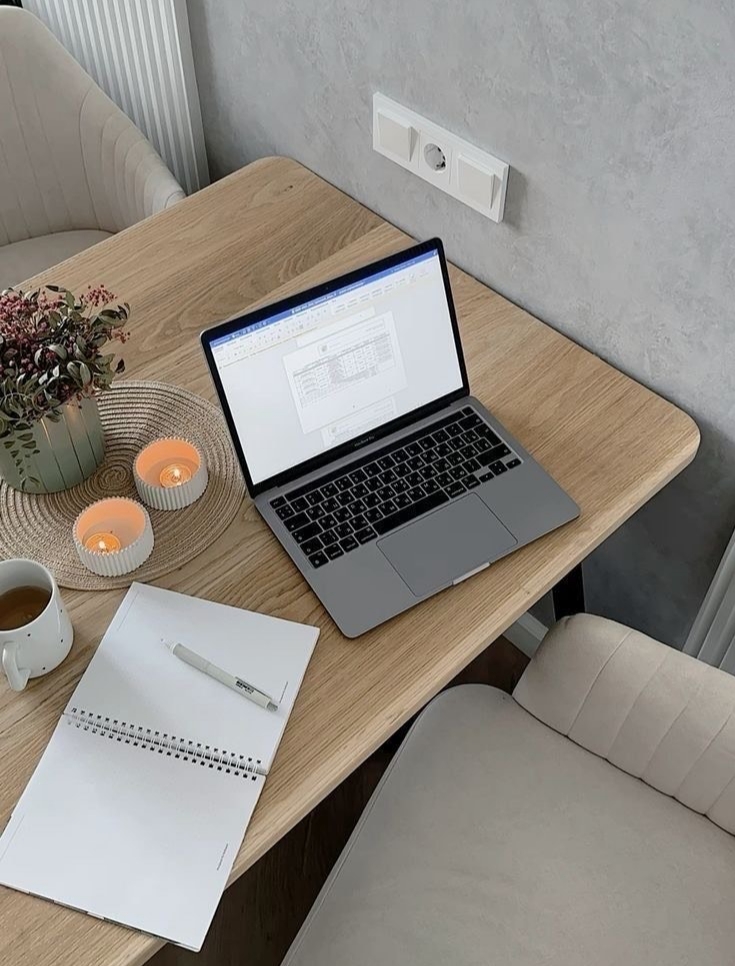
A soft, neutral office desk with an open laptop, a notebook, a cup of coffee and two small candles. Warm light, beige tones and a quiet workday atmosphere that reflects gentle boundaries and office fatigue.

There is a version of burnout that does not look dramatic.
You still answer emails. You still show up on time. You still say “Sure, I can take that too” with a small smile.

From the outside, you look reliable.
On the inside, you feel like a walking inbox that never closes.

If you are the kind person at work who absorbs everyone else’s urgency, you probably learned two quiet rules:

  • Do not make things harder for others.
  • Do not sound rude, ungrateful, or difficult.

So you take the extra tasks. You stay late. You say yes when every cell in your body whispers no.

This is not a motivation post.
This is for the version of you that is tired, but finally clear enough to say: something has to change, and I cannot wait for HR or a perfect manager to rescue me.

You do not need a full communication strategy to start.
Sometimes you just need a few simple sentences that act like a soft fence around your energy.

Below are five gentle but firm phrases for office workers who want to protect their energy at work without turning into someone they do not recognize.

You do not have to use them perfectly.
You just have to use them once. Then again. Then again, until your nervous system starts to understand that you are also on your own priority list.


1. “I want to give this the attention it deserves, and I do not have the capacity for it today.”

This is for the moment when someone appears at your desk or in your inbox with a small thing that is not small at all.

You know that feeling. Your brain is already overloaded, your to do list is long, and they say the sentence that always traps you:
“It will just take a few minutes.”

Instead of swallowing the panic and saying yes, try this:

“I want to give this the attention it deserves, and I do not have the capacity for it today.”

Why it works:

  • It shows that you care about quality, not just speed.
  • It uses the word capacity which is factual, not emotional.
  • It sets a boundary without blaming them or apologising for existing.

Variations you can use:

  • This needs more focus than I can give it today.
  • My plate is full for today, I do not have the capacity to add this.

If you want to soften even more, you can add a follow up:

  • Can we look at this tomorrow morning instead
  • Could you check with X as well, they might be able to help sooner

2. “That does not work for me, but here is what I can do.”

This is a simple phrase for kind people who hate the word no.

You have been trained to offer yourself, to be flexible. So a hard no feels like you are slamming a door.

This sentence gives you another option. It lets you say no to the shape of the request while still offering something that feels true for you.

“That does not work for me, but here is what I can do.”

For example:

  • Staying late today does not work for me, but I can come in a bit earlier tomorrow.
  • Joining another weekly meeting does not work for me, but I can read the notes and share my input in writing.
  • Taking full ownership of this project does not work for me, but I can support with the first draft.

Why it works:

  • That does not work for me is clear, but not aggressive.
  • You introduce your own limits without over explaining.
  • You redirect the conversation toward a solution that respects your energy.

You are not a wall. You are also not a door that everyone walks through. You are a person who can negotiate.


3. “I can do this, but I will need to pause X. Which is more important right now”

This is one of the strongest boundary phrases for kind people at work, especially when your boss or colleague tries to add just one more thing on top of your current deadlines.

Most office workers secretly rearrange their entire day in silence. They say yes, then stay late, then burn out, then wonder why no one protects them.

If you do not show your limits, most workplaces will pretend they do not exist.

Try this instead:

“I can do this, but I will need to pause X. Which is more important right now”

Or:

  • I can start this today, but that means the report will move to tomorrow. Which one should I prioritize
  • I can help with this, but then the client deck will be delayed. What is more urgent from your side

Why it works:

  • You are not refusing to help. You are naming trade offs.
  • You move the responsibility for prioritizing back to the person who is adding work.
  • You train people to see your time as a finite resource, not an elastic one.

4. “I am at capacity right now, so I will have to say no to this one.”

Sometimes you do not have an alternative to offer.
Sometimes the answer is simply no.

You might already feel your body react to that idea. Tight chest. Heat in your face. Old fear that you will be seen as lazy, difficult, or ungrateful.

That is why this sentence exists. It is short. Clean. Honest.

“I am at capacity right now, so I will have to say no to this one.”

You are not defending yourself. You are not writing an essay about your mental health, your evening plans, your family, or your inbox size. You are not begging them to understand.

You are stating a fact.

  • I am at full capacity this week, so I will say no to any new tasks.
  • My schedule is full, so I cannot take this on.
  • I wish I could help, but I am at capacity.

Every time you say yes when you mean no, someone else gets your best energy while you get the leftovers.


5. “I am logging off for today and will look at this tomorrow with a clear head.”

This phrase is for the moment when work tries to leak into every corner of your evening.

The late email.
The quick question on chat.
The file that arrives one minute before you shut your laptop.

You tell yourself it is easier to just do it now. You answer. You open the file. You send the edit. Your body never fully understands that the workday ended because it never truly does.

Try a different ending:

“I am logging off for today and will look at this tomorrow with a clear head.”

If someone messages you near the end of your day:

  • I am logging off for today and will look at this tomorrow with a clear head.
  • I saw this, I will handle it tomorrow morning when I am back online.
  • Thanks for sending, I am offline now and will review it first thing tomorrow.

You do not have to reply to everything immediately in order to be loyal or professional.
Sometimes the most professional thing you can do is protect your own ability to function long term.


If all of this feels uncomfortable, that is normal

If these phrases feel heavy in your mouth, you are not broken. You are just not used to having choices.

Most kind people learned very early that their safety depended on being agreeable.

So of course it feels wrong to say no or that does not work for me or I am at capacity. Your nervous system thinks you are risking everything.

You are not.
You are adjusting the weight you carry so that you can stay a kind person without disappearing.

You do not have to use these perfectly. You do not have to become someone else.

Start smaller.

  • Pick one phrase from this list.
  • Write it on a sticky note near your screen.
  • Use it once this week, even if your voice shakes.

That is enough for now.

Boundaries are not about becoming perfect or finally getting it right.
They are about choosing yourself in small moments until your life feels like it actually belongs to you.


Something gentle for when you feel yourself slipping again

And if you want something soft to hold onto for the days when work feels heavier than it should, here is the guide I made for exactly that moment:

Download the free Soft Growth Reset PDF

Leave a Comment